
AI Explorations:
2. Chasing The Elite
Chasing The Elite
From AI Output to Intentional Design
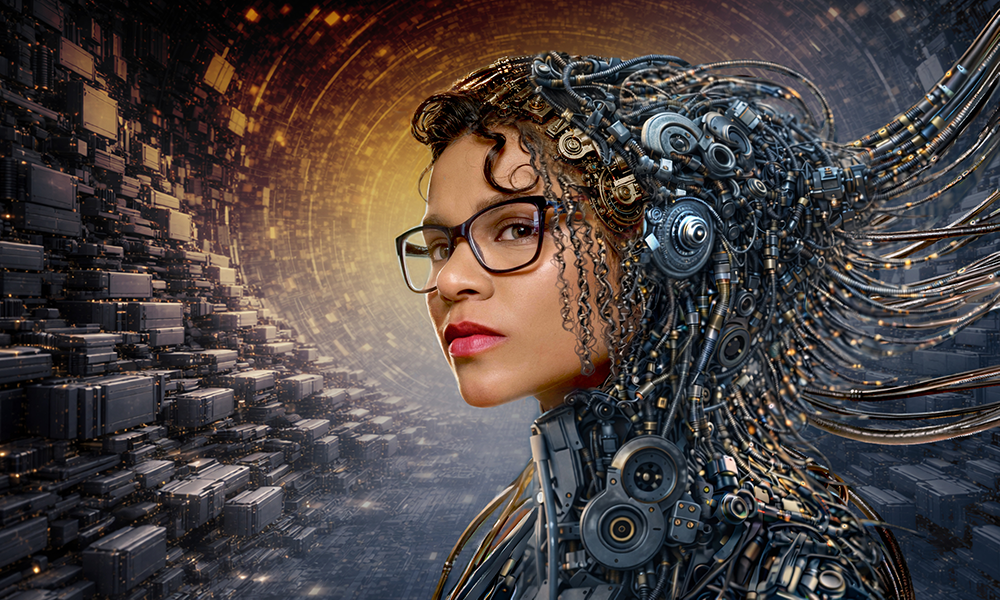
Art Director's Perspective
This exploration began with a much simpler objective than the final work might suggest.
Inspired by the interesting Adobe Stock Photo #614645174 of an abstract, Cybernetic 3D Woman, I wanted to create a futuristic version of myself that felt cinematic, dimensional, and believable. My expectation was that maintaining my likeness would be straightforward. After all, one of AI's most widely promoted capabilities is the ability to transform a person's photograph into almost any scenario while preserving their identity.
The assumption seemed reasonable: upload a reference image, describe the destination, and let the technology handle the rest.
Instead, the opposite happened.
While the early results were often visually impressive, they frequently altered facial structure, skin tone, age, ethnicity, and other defining characteristics. Some images looked polished and realistic, but no longer looked like me. Others preserved fragments of my appearance while losing the atmosphere, sophistication, or realism I was trying to achieve.
What began as an exploration of cybernetic portraiture quickly became an investigation into something much more interesting: the tension between image quality and identity preservation.
As the work evolved, the challenge shifted from generating attractive images to directing consistency across multiple AI systems, styles, prompts, and visual interpretations. The process became less about accepting what the tools produced and more about art direction, refinement, and learning how to guide the technology toward a specific creative vision.
The final images represent more than a successful cyborg portrait. They document the point where experimentation became direction, prompting became iteration, and AI became a creative tool that could be shaped rather than simply observed.
My Contribution
Art Direction • Prompt Development • Cross-Platform AI Workflow • Identity Preservation • Photoshop Compositing & Refinement.
This exploration wasn't about creating a single successful image. It was about understanding how different AI systems excel at different tasks, then directing them together into a workflow that produced results no single platform could achieve on its own.
Overview
Chasing the Elite began with a simple question: Why do some AI-generated images feel exceptional while others feel merely generated?
Inspired by a cybernetic portrait that combined realism, atmosphere, and technical sophistication, the goal was to create work that reached a similar level of refinement while maintaining a recognizable human subject.
What followed became a much deeper exploration: How to preserve true facial identity across AI tools that often generalize, distort, or overwrite it. The challenge wasn't simply aesthetic. It was about control.
Using ChatGPT DALL·E, Leonardo AI (Flux and Seedream), and Adobe Photoshop, the project evolved into a study of likeness, consistency, atmosphere, and creative direction, pushing beyond acceptable results in pursuit of images that felt intentional, believable, and complete.
The Challenge
Early attempts using AI image generators produced visually interesting results, but they failed in one critical area:
• Facial likeness was inconsistent.
• Skin tone and undertones shifted unpredictably.
• Features were often reconstructed rather than preserved.
The results reflected a broad interpretation of a Black woman, but not the nuance of a mixed-race identity with lighter complexion and specific facial structure.
At this stage, the work felt more like approximation than authorship.
Chasing The Elite - Source Images
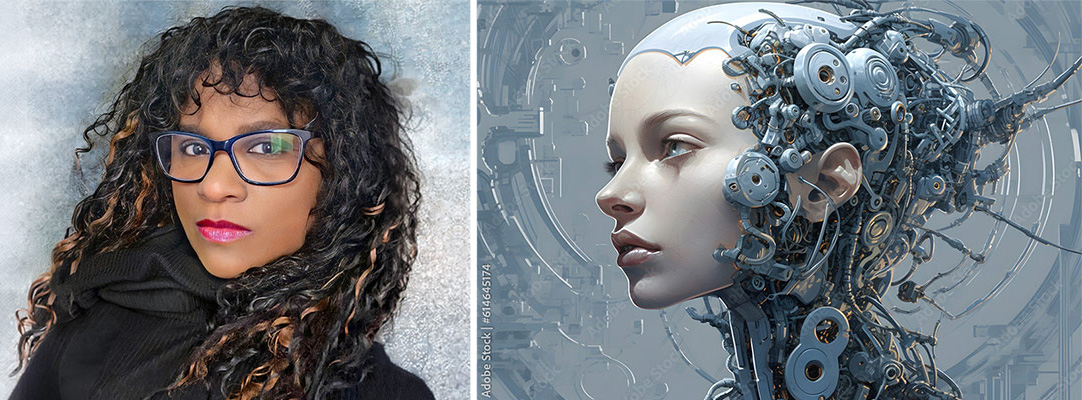
Initial Direction
From the beginning, four things mattered equally:
• Human identity.
• Mechanical integration.
• Cinematic lighting.
• A strong sense of environment and depth.
The reference point leaned toward high-end editorial and concept art, where realism and design exist in the same space.
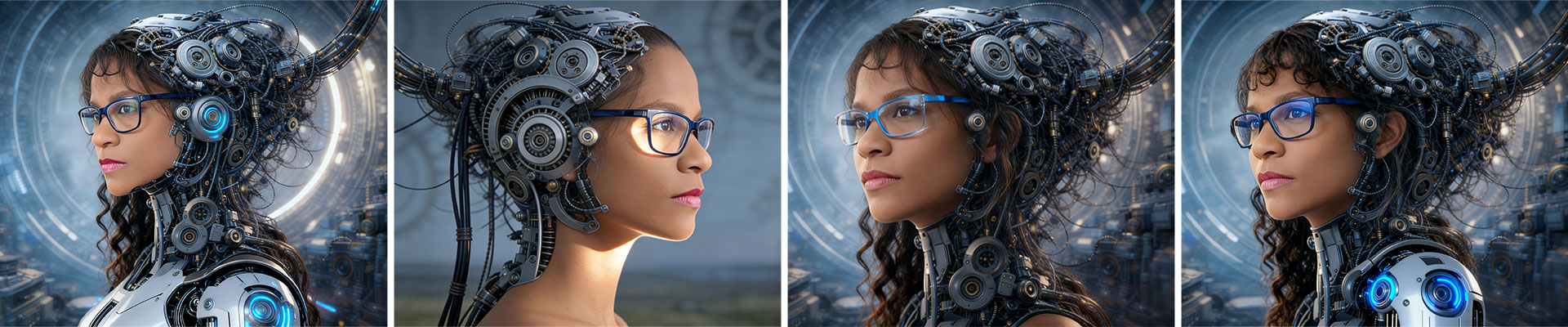
ChatGPT / DALL·E
Early ChatGPT/DALL·E attempts that missed the likeness. Note how the image became progressively softer and noisier, with each iteration. Also, see its inability to maintain the subject's complexion, usually going much darker than required.
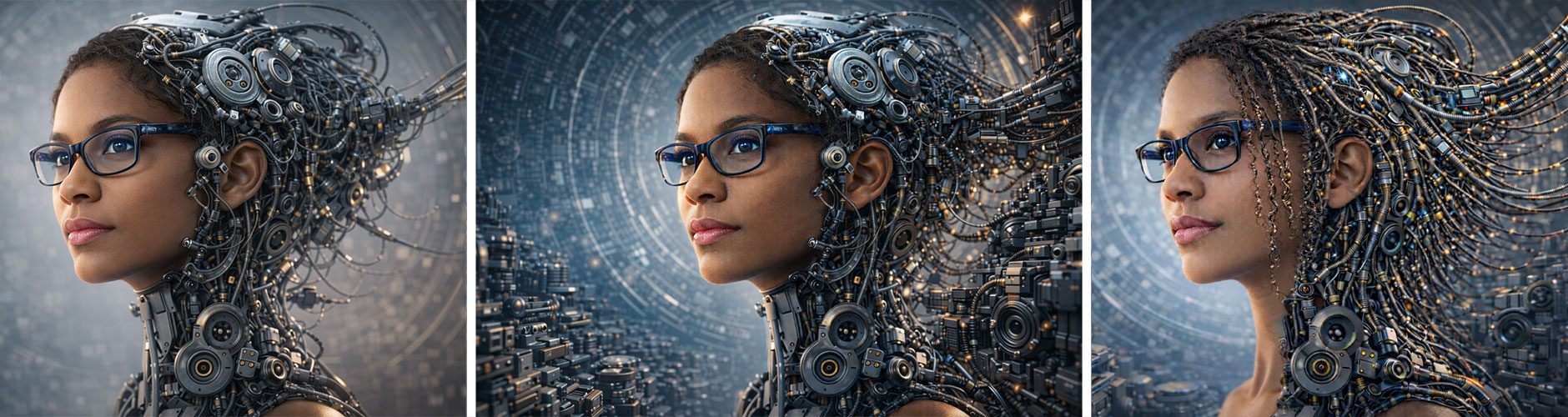
The Starting Point
The early stages followed a familiar path. ChatGPT and DALL·E. With them I was able to generate compositions with strong mood and structure, but the face remained the weakest point. Each iteration required correction:
• Adjusting proportions.
• Fixing asymmetry.
• Reworking skin tone.
• Trying to “pull back” toward the original identity.
This slowed the process and made consistency difficult across variations.
Recognizing the Ceiling
At this point, the limitations became obvious. While ChatGPT and DALL.E were good at composition, lighting, mood and structure, it was clear that one system could not deliver everything. Instead of continuing to push within the same boundaries, the process expanded.
Shifting Between Systems
This is where the workflow became intentional and layered. The process moved across platforms, each chosen for a specific strength:
Then back again. ChatGPT to refine. Leonardo|Seedream to correct. ChatGPT to reshape. Flux to enhance. This was not linear. It was iterative, selective, and controlled.
Base Prompt
• Use the provided image as the identity reference. Preserve exact facial identity, proportions, features, and likeness. Do not alter the face.
• Side profile portrait (left-facing), head and neck visible. The head occupies the center third of a wide landscape composition, with balanced negative space on both sides.
• Replace hair and back of head with intricate biomechanical structures: layered machinery, circular components, cables, tubes, and fine mechanical detailing seamlessly integrated into the skull and neck.
• Face remains fully human with smooth, porcelain-like skin—soft, luminous, refined, but realistic.
• Soft cinematic lighting with a strong rim light along the front edge of the face for separation. Subtle highlights on skin, controlled reflections on metal.
• Cool-toned mechanical environment (grays, silvers, muted blues) contrasting with natural warm skin tones.
• Shallow depth of field, sharp focus on face, background softly blurred with abstract circular mechanical elements.
• Hyper-realistic, cinematic, high-end sci-fi concept art, clean and elegant.
Negative Prompt
• Distorted face, altered identity, different person, asymmetry, extra eyes, cartoon, anime, stylized, exaggerated features, duplicate face, blurry skin, plastic skin, harsh lighting, deformed anatomy.
Added Refinement
• Designed as a premium sci-fi film concept render with art direction quality similar to high-end cinematic VFX.
Leonardo / Seedream
Closest to Facial Accuracy: Likeness Anchor produced based on my Image and the Basic Prompt
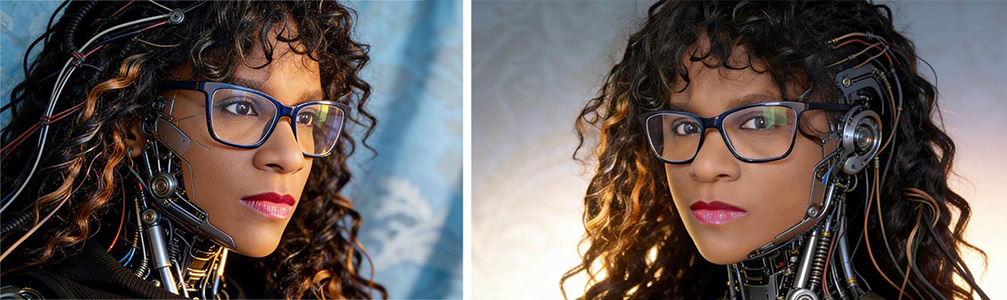
Leonardo / Seedream
Likeness Anchor produced based on my Image for likeness and ChatGPT Image for Composition and Style
The Long Middle
This is where most of the work lived. Not in the beginning. Not at the end. But in the constant back and forth.
• One version would get the lighting right.
• Another would get the likeness right.
• Another would capture the structure.
But none of them delivered everything at once. So the process became a series of decisions:
• What to keep
• What to discard
• What to rebuild
There were moments where the image felt close enough to stop. Close Enough (based on prompt, not the Adobe Source Reference): in that the Seedream AI produced 2 truly breathtaking images, that had strong cinematic lighting and cool technological/scifi atmospheres. But “close enough” was never the goal.
Refusing “Good Enough”
This is what defined the entire process. There were several points where the work was strong enough to stop. The composition worked. The atmosphere was there. The likeness was improving. But "good enough" was never the goal. Every promising result became a starting point for asking one more question: How much further could I push it?
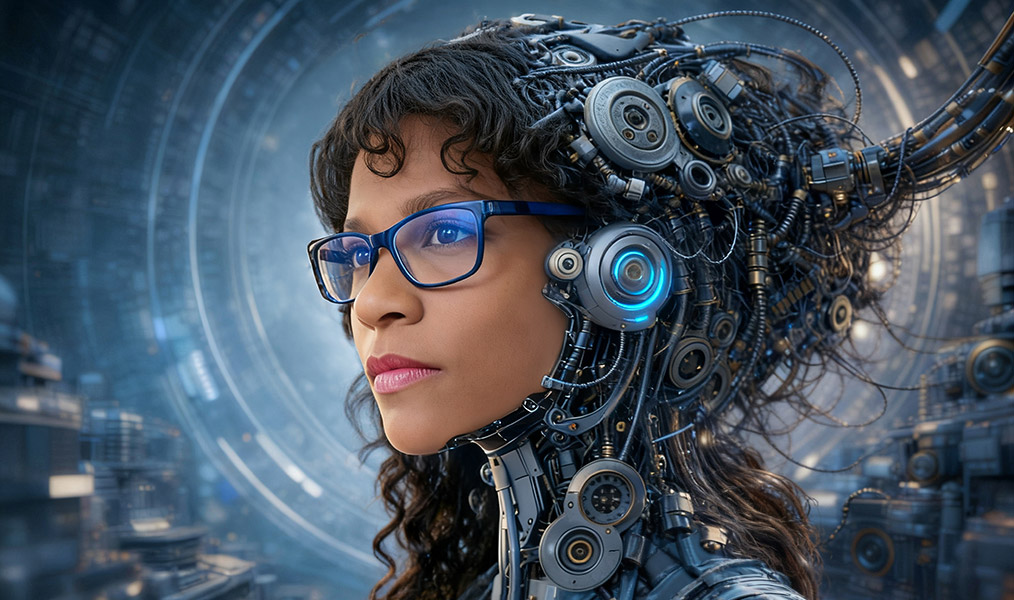
Leonardo / Seedream
The Seedream Exploration Image that came closest in likeness to the Adobe Source Reference and the Prompt
When "Good Enough" Wasn't Enough
This image represented a breakthrough. For the first time, the original objective had been achieved. The likeness held. The biomechanical integration felt believable. The result captured the elegance and dimensionality that had inspired the exploration from the beginning. And, I could have stopped here. But "good enough" was never the goal.
The remainder of the process became an exploration of what happened after the problem was solved: pushing atmosphere, emotion, lighting, and storytelling beyond accuracy and into authorship.
Additionally, the image wasn't the product of a single successful prompt. It emerged through a process of evaluation, selection, and refinement that defined the entire exploration. Seedream provided stronger likeness anchors, but the final result still required intervention in Photoshop: combining multiple outputs, restoring details, refining the cybernetic integration, removing inconsistencies, and preserving the visual decisions that mattered most.
Looking back, this was the point where the original objective had been achieved. The Adobe inspiration had evolved into a portrait that felt cinematic, dimensional, and recognizably mine. Everything that followed became an exploration of how much further the work could go.
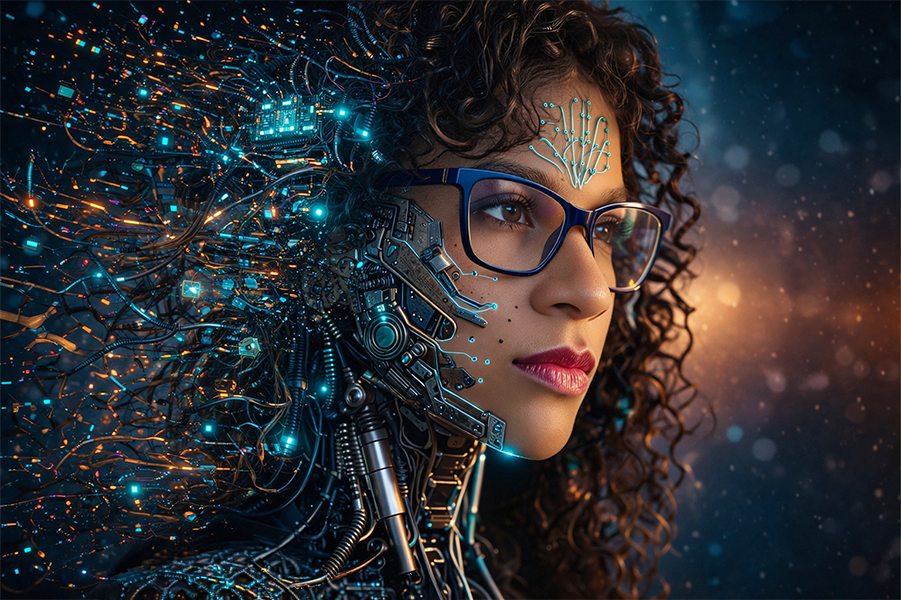
Leonardo / Seedream
Seedream Exploration Results based on the Initial Prompt: Version A – Leans toward flowing illuminated circuitry, particle trails, energy streams, neural-network visualization, organic data flow, and dynamic movement.This gives that beautiful explosive effect in the hair.
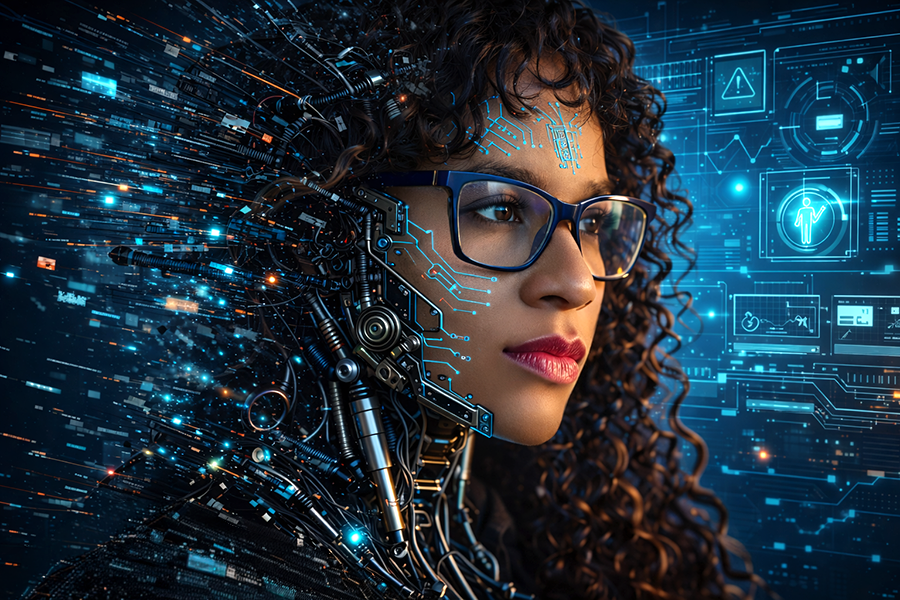
Leonardo / Seedream
Seedream Exploration Results based on the Initial Prompt: Version B – Leans toward holographic interface panels, system diagnostics, digital architecture, information displays, and advanced user interface graphics. This gives the structured HUD-style background.
The Cost of Iteration
The finished image above, became the springboard for pushing further. However, every time I took the strong likeness anchor images from Leonardo | Seedream into ChatGPT to integrate the background and environment, I would lose the face. The identity drifted with each iteration. That was the biggest challenge. The more iterations that were introduced, the more the face started to break down. Details softened. Features shifted. Structure drifted.
Instead of improving, each new iteration solved one problem while introducing another. Identity drift increased. Fine details softened. Facial structure shifted. The image became less coherent instead of more refined.
This cycle repeated several times, moving back and forth between various AI generators to find the closest likeness anchor images, then returning to ChatGPT to integrate the background and create a unified environment. But there was always something slightly off. Something that broke the illusion.
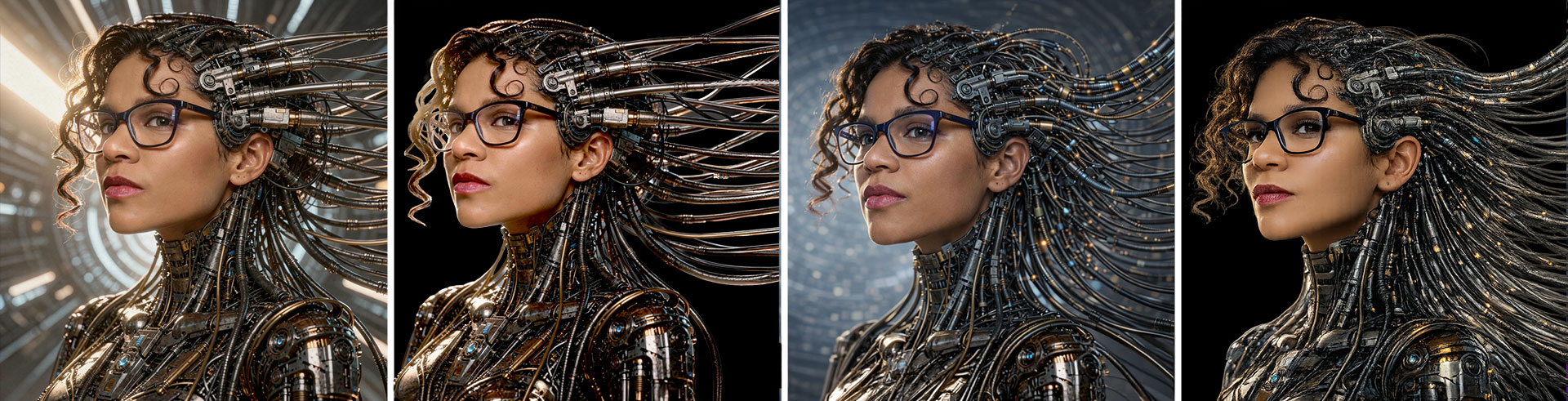
Switching to Leonardo AI with Flux 2.0 enabled significantly stronger facial consistency and structural coherence. Flux provided better likeness retention, and more controlled mechanical detail.
The Breakthrough
The turning point came when the process stopped relying on a single output. Instead of trying to get one perfect image, the approach shifted to building the final result from multiple strengths.
• Pulling the best likeness from one system (Seedream)
• The strongest lighting and composition from another (ChatGPT), and
• The most convincing material detail from another (Flux)
• Combining the best of those images in Photoshop, and refining them
This is where the image started to feel cohesive. Not generated. Designed.
Leonardo | Flux 2.0
Flux Exploration Image with Likeness Preservation, and ChatGPT's struggle to maintain it.
Final Control (Photoshop)
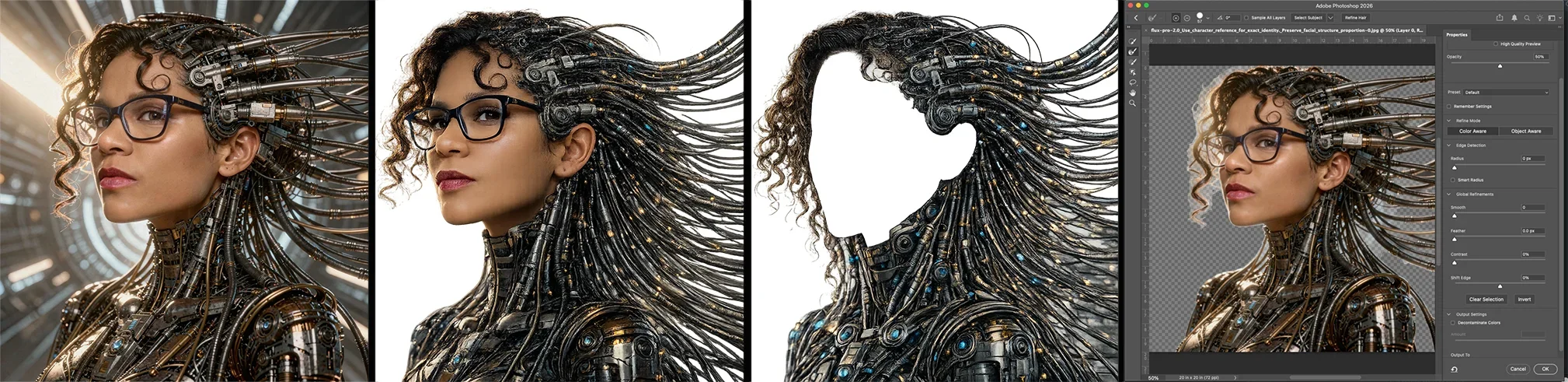
The final composition was constructed in Photoshop, where control over detail, selection, masking, and lighting became critical. As such, Photoshop became the final step, not as a correction tool, but as a refinement layer.
This is where everything came together.
Photoshop Refined
Photoshop Refinement: The best Likeness Preservation Image plus the best Image Composition were combined, and the Lighting and Atmoshere corrected in Photoshop to produce well-balanced, cohesive final images.
Build Phase (Photoshop)
Rather than choosing a single outcome, the project evolved into an exploration of tone, demonstrating how lighting and color dramatically shift the emotional impact of the same subject.
Direction A — Cool and Controlled
• Clean
• Minimal
• Technical
• Editorial
Direction B — Warm and Cinematic
• Energetic
• Atmospheric
• Narrative-driven
The Result
The final images did not feel like an output. They felt intentional.
• The likeness held
• The lighting had depth
• The materials felt integrated
• The composition supported the subject
It reached the level that the process was aiming for from the beginning.
Photoshop Refined
Photoshop Refined Final Image with Warm, Energetic, Golden-Orange CinematicLighting
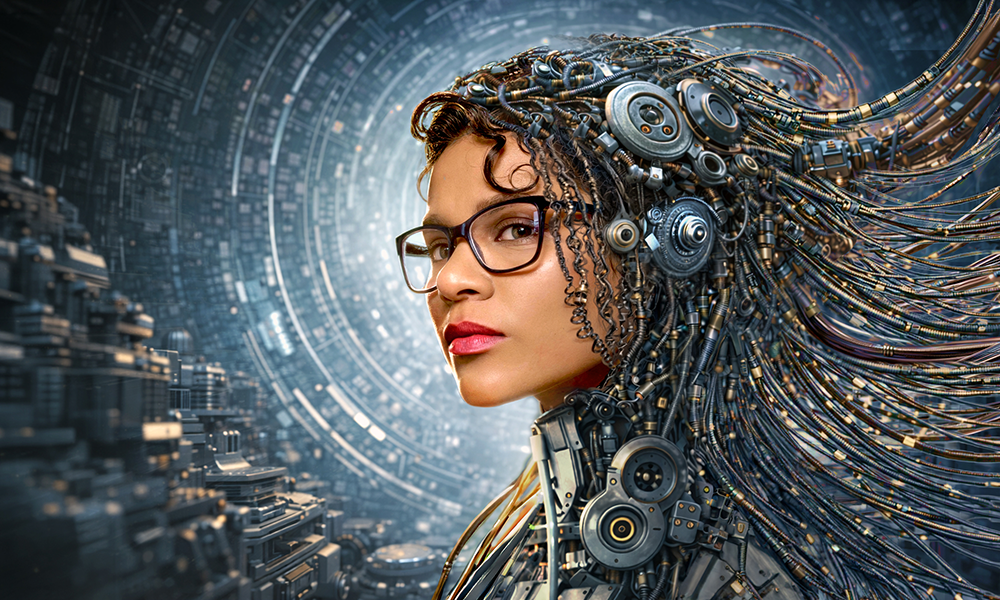
Photoshop Refined
Photoshop Refined Final Image with clean, controlled, Cool Blue Environmental Lighting.
What This Process Revealed
This case study made one thing clear. AI alone does not produce exceptional work. But it can be part of an elite process. The difference comes down to:
• Direction
• Selection
• Judgment
• Persistence
And knowing when to move between tools instead of forcing one to do everything.
The goal isn't always to force the machine to reproduce the exact concept in your head. Sometimes the goal is:
• Follow the concept.
• Learn from the outputs.
• Keep what works.
• Discard what doesn't.
• End up somewhere better than where you started.
That's what happened here. I started chasing the Adobe image. I ended up with something that is clearly inspired by it, but is no longer trying to copy it. That's not failure. That's design evolution.
Refined (Reverse Engineered) Prompt
Futuristic cybernetic portrait of a mixed-race woman with golden-brown skin, natural curly hair, and rectangular dark-blue eyeglasses. Preserve exact facial identity and recognizable likeness. Advanced biomechanical integration seamlessly woven through the hair, neck, and shoulders. Dense network of cables, mechanical components, gears, connectors, and intricate cybernetic architecture integrated into organic forms. Cinematic realism, highly detailed mechanical craftsmanship, photorealistic skin texture, natural expression, intelligent gaze.
Background consists of a large circular futuristic interface with layered digital architecture and soft atmospheric depth. Cool blue and silver color palette. Clean technological environment. Volumetric lighting, subtle rim light, shallow depth of field, professional concept art quality, ultra-detailed, premium sci-fi editorial photography, believable engineering, cinematic composition.
Add-on Modifier
Replace cool blue environmental lighting with warm golden-orange cinematic lighting. Introduce illuminated architectural forms and glowing city-like structures on the left side of the composition. Increase atmospheric contrast between warm gold highlights and cool metallic shadows. Add subtle glowing particles, warm energy sources, amber reflections across mechanical surfaces, richer depth, stronger cinematic mood, premium sci-fi city atmosphere, dramatic environmental storytelling.
Conclusion: A New Way of Working
This was not just an experiment. It changed the approach. AI became:
• A starting point
• A toolset
• A collaborator
But never the final decision-maker.
Additionally, in spite of iterations and constraints, I solved identity and realism across multiple AI systems and brought them together in Photoshop. This process wasn't fast, and it certainly wasn't predictable. But it demonstrated something important: exceptional work rarely comes from a single prompt or a single tool. It comes from clear direction, persistence, thoughtful decisions, and the willingness to push beyond "good enough." With the right approach and the right tools, it is possible to take something generated and turn it into something crafted. Something intentional. Something complete.
OUTCOME: What This Work Demonstrates
Multi-platform AI literacy: Understanding what ChatGPT, DALL.E, Leonardo, Seedream and other AI platforms do well, and building a cross-tool workflow that uses each platform for what it actually excels at rather than forcing one tool to carry everything.
→Art directing AI rather than following it: Moving from describing what the image should be to controlling what it cannot do, knowing when more iteration is making things worse, and understanding identity drift before it takes the image in the wrong direction.
→Prompt architecture as craft: Building prompts that separate identity preservation, transformation mechanics, rendering style, composition, and transition alignment into explicit, distinct instructions, and using negative prompts as structural creative decisions.
→Photoshop as the finishing layer: Understanding that AI gets you most of the way there, and that the final level of polish, the part that makes the difference between generated and designed, still requires a human hand, a trained eye, and an uncompromising standard.