
AI Explorations:
1. Reconstructing Identity
Reconstructing Identity
From Pencil Sketch to Cybernetic Realism
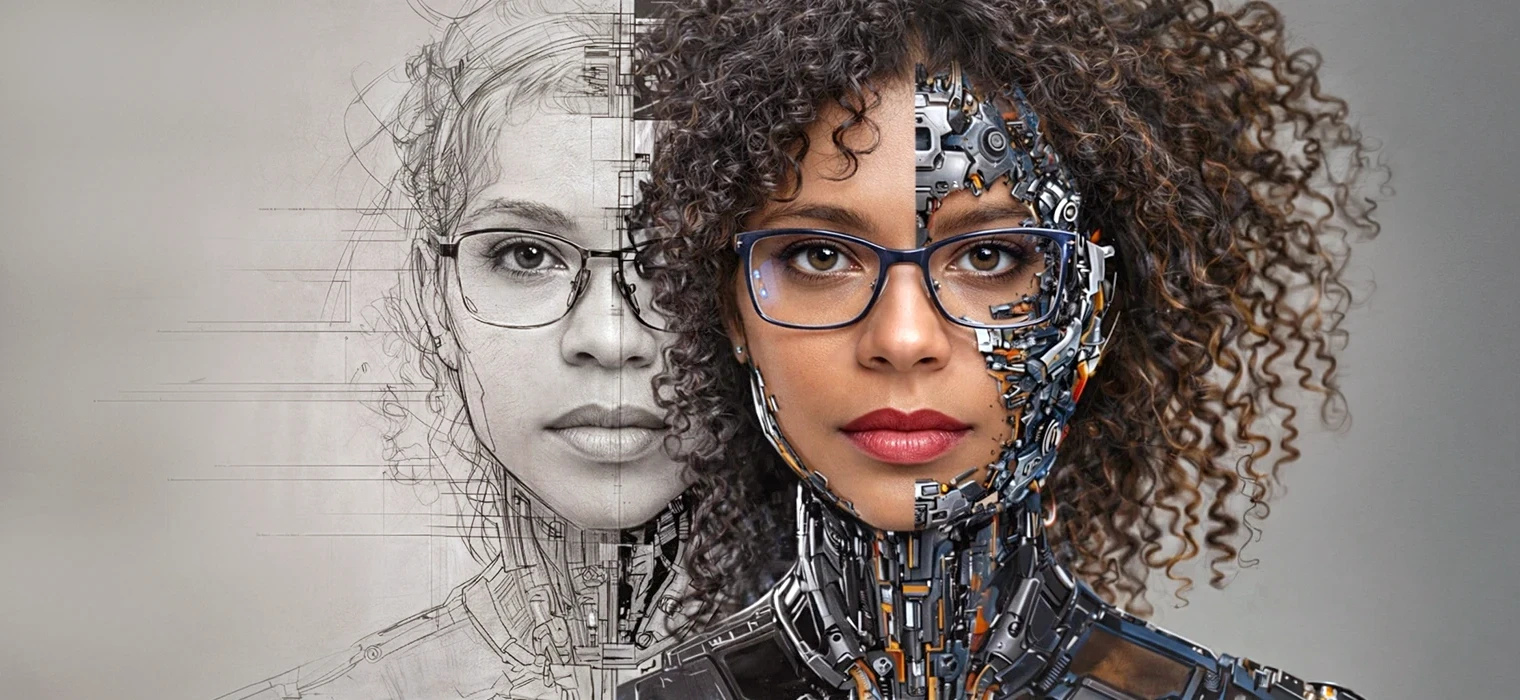
Reconstructing Identity
Humans have always been in the business of transformation. From the moment we picked up a tool, we began remaking ourselves. The caveman who sharpened a stone extended his reach beyond flesh. The blacksmith who forged metal became part machine. The surgeon who replaced a failing organ blurred the line between natural and constructed. Every technology is an act of self-augmentation. Every tool is an argument about what we can become.
This project explores that idea through AI. It asks: What happens when we use AI not to create fantasy, but to explore a future that already feels possible? Could one face move convincingly from pencil sketch, to photograph, to cybernetic augmentation while remaining unmistakably the same person?
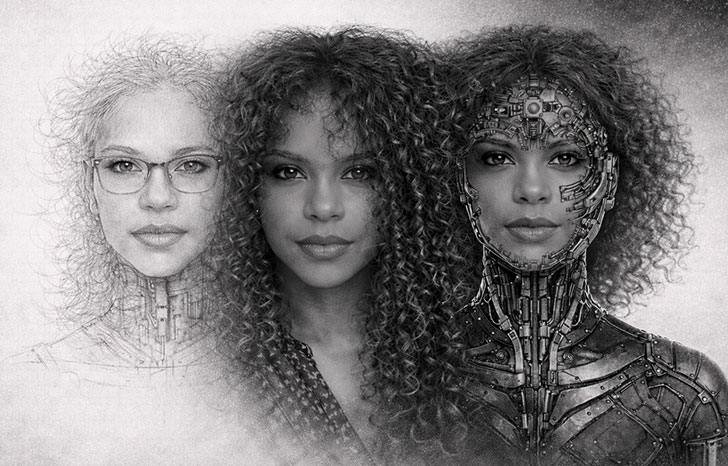
The concept was simple on the surface. A single portrait in transformation. One face. Three states. One unbroken identity moving from hand-drawn blueprint through photorealistic present into augmented future. But getting there revealed something more interesting than the image itself: What these tools can and cannot do, where they drift, where they hold steady, and why the final polish still belongs to human hands.
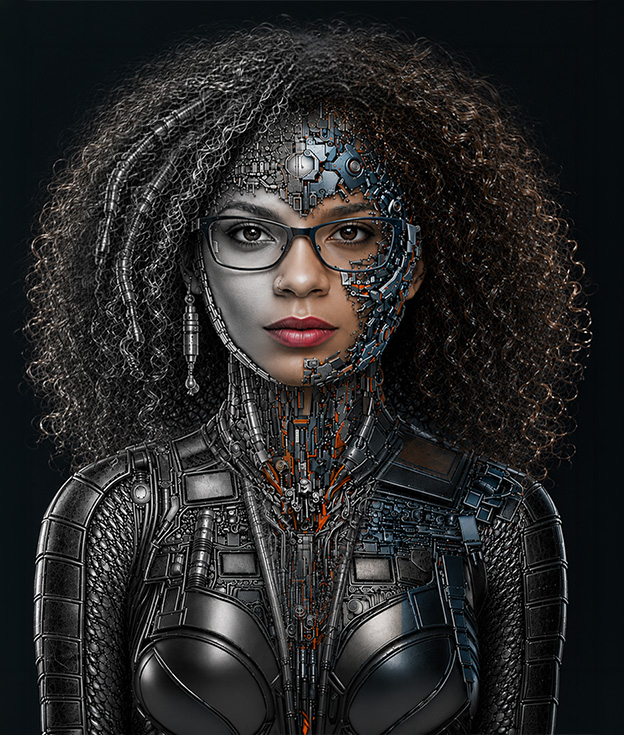
CLICK ON IMAGE to view larger.
Exploration 1 explores what happens when traditional design thinking meets emerging tools. It delves into Identity, Control, Style, and Precision. It traces the larger idea: How we move from simple to complex. From analog to digital. From human-made to machine-assisted. Not as a replacement, but as an extension of creative control.
My Contribution
Art Direction • Prompt Development • Cross-Platform AI Workflow • Identity Preservation • Photoshop Compositing & Refinement. This exploration wasn't about generating interesting images. It was about understanding where AI excels, where it breaks down, and how creative direction bridges the gap between machine output and finished design.
This is the story of that two-to-three-day push. What follows is an honest account of both the breakthroughs and the failures.
The Starting Point: Real Reference, Specific Identity
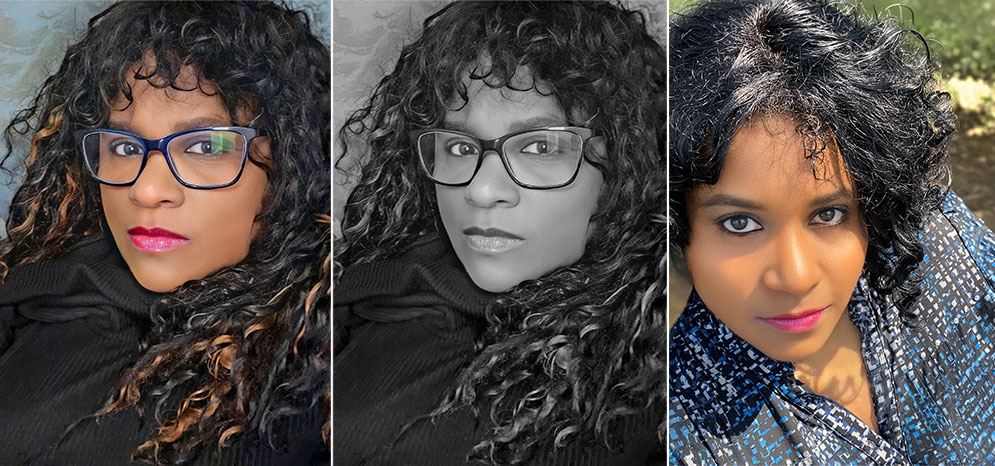
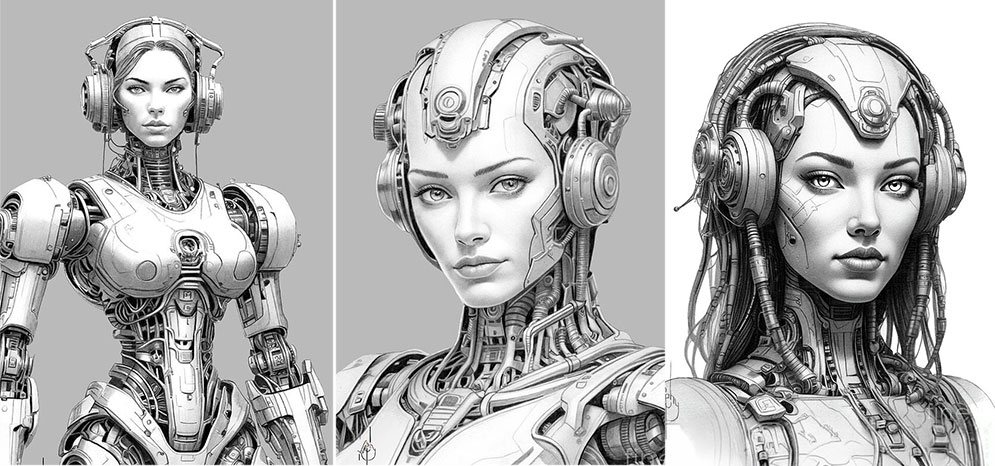
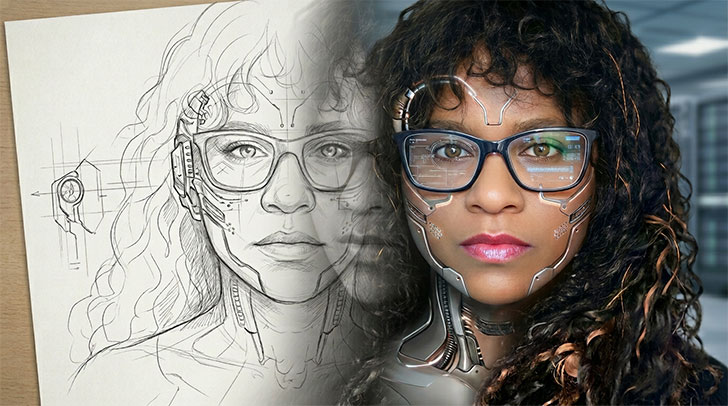
The project began with three source photographs, two color, one black and white, along with reference images of Murphy A. Elliott's highly detailed pencil illustration work, found online. The goal was clear: take a real, specific face with recognizable features, curly hair, glasses, distinct skin tone, and transform it into a cybernetic concept while holding that identity throughout every stage of the transition.
Three reference illustrations were selected to establish the style and level of detail the pencil work should achieve. Intricate mechanical line drawing with expressive draftsmanship. These defined the visual language, not the subject.
Source Reference: Color and Black and White Portraits
Style Reference: Detailed Pencil Illustration Work by Murphy A. Elliott
The Base Prompt
The initial prompt was detailed and specific, attempting to establish every parameter upfront:
"Transform this portrait into a futuristic cyborg concept artwork while preserving her exact facial identity and proportions. Landscape composition, subject on the right occupying two-thirds of the frame. Create a visual transition across the image: the far left begins as a stylized digital illustration with sketch-like mechanical elements, transitioning into black-and-white realism in the middle, and ending in full-color photorealistic cyborg detail on the right. Integrate intricate biomechanical components that are strongest near the face and dissolve outward. Ensure seamless blending between styles while maintaining consistent facial structure. High detail, cinematic composition, sharp focus, no distortion, no extra features, no text."
The concept was clear. The direction was precise. What came back was not what was asked for.
The First Problem: Stuck on Triptych
ChatGPT and DALL·E immediately defaulted to three-panel compositions. Left panel: sketch. Middle panel: human. Right panel: cyborg. Cleanly separated, clearly labeled, completely wrong. The system understood the concept as sequential storytelling and kept returning to that structure regardless of how tightly the constraints were written.
The prompts had to stop describing what the image should be and start controlling what it absolutely could not do. No multiple panels. No repeated faces. No segmentation. One subject only. Once the constraints tightened, the outputs began moving in the right direction, still not there, but no longer completely off concept.
ChatGPT / DALL·E
Early Output: The Triptych Problem
The Second Problem: Losing the Face
Even when the structural problem was resolved, a deeper issue emerged: identity drift. With each iteration, the face moved further from the source reference. Features softened. Skin tone shifted. Proportions changed in ways that were subtle but unmistakable. What came back looked like a generalized version of a person rather than a specific one.
This is the behavior most people do not anticipate. AI does not refine the way a designer would. It rebuilds from scratch with every generation, working from probability patterns rather than memory. Each pass is a reinterpretation, not a correction. Push it too many times and it starts working against you. The image gets muddier, not clearer.
The face that started recognizable became progressively less so. Features broadened. The curly hair changed texture. The glasses, a consistent and distinctive identifier, began to distort or disappear entirely.
ChatGPT / DALL·E
Identity Drift: When More Iterations Made It Worse Click on image to VIEW LARGER
The Pivot: Different Tools, Different Strengths
At a certain point it became clear that no single tool was going to deliver the full concept. Each platform had its own strengths and limitations, and understanding those distinctions was what shifted the process from frustrating to productive.
ChatGPT / DALL·E was strong on composition, mood, and visual storytelling structure. But it consistently struggled with exact facial likeness, particularly for specific individuals with distinctive features, and identity drift accumulated with repeated iterations.
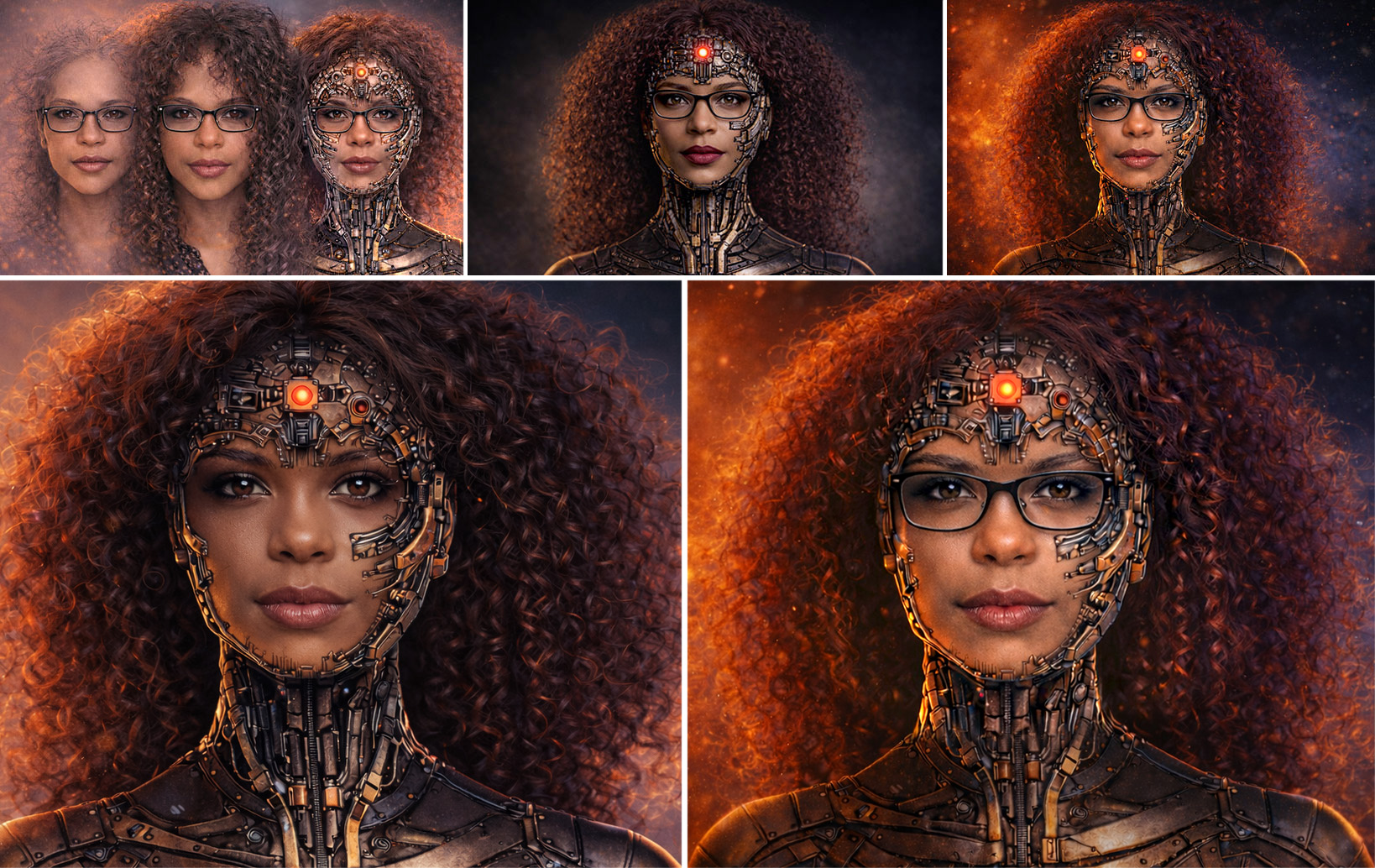
Firefly / Gemini Flash produced realistic facial likeness with minimal compositional framing.The skin tone was inconsistent across outputs. Two images landed correctly. The other two came back muddy, which made it unreliable as a likeness anchor. Useful for exploring direction, not for final creative decisions.
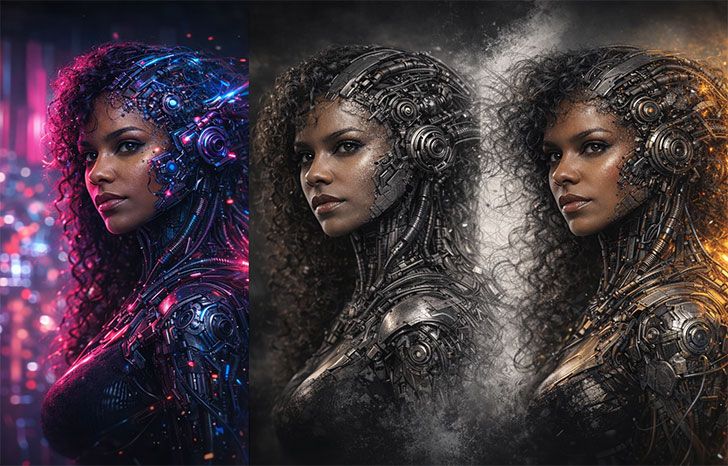
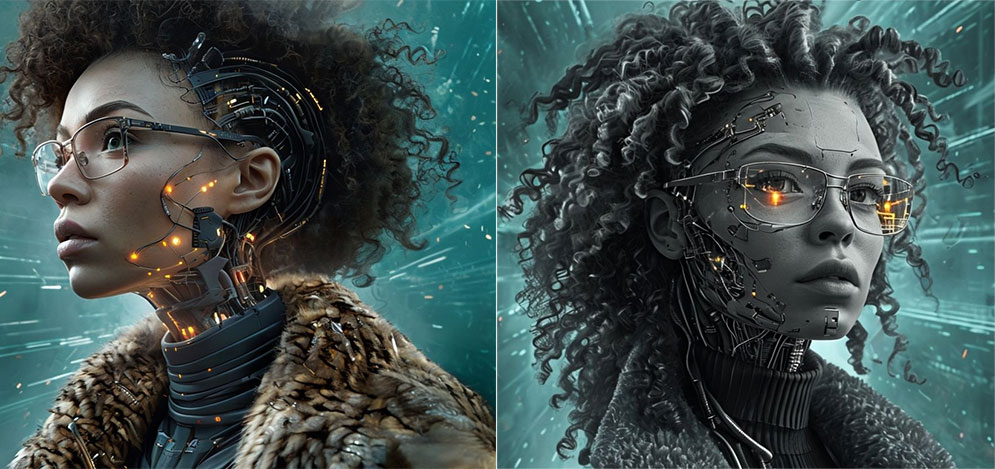
Playground AI delivered dramatic, stylized cybernetic illustrations with real visual energy. It started pushing things in the right compositional direction, before likeness accuracy became the limiting factor.
Leonardo and Seedream came closest to capturing facial accuracy, responding more effectively to reference images and producing results that actually looked like the source subject. This became the likeness anchor for the cross-tool workflow.
The solution was not choosing one tool. It was building a workflow that used each one for what it did best: start with likeness using Leonardo and Seedream, then bring those outputs into other systems for compositional refinement and mood development.
Firefly / Gemini Flash
Photorealistic Cyborg Explorations
Playground
Direction One: Dramatic Cybernetic Explorations
Leonardo / Seedream
Closest to Facial Accuracy: The Likeness Anchor
The Breakthrough: Cross-Tool Workflow
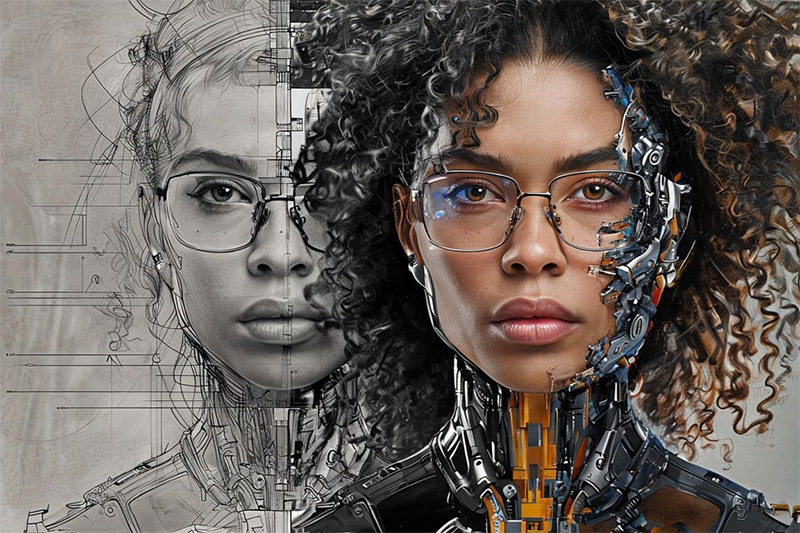
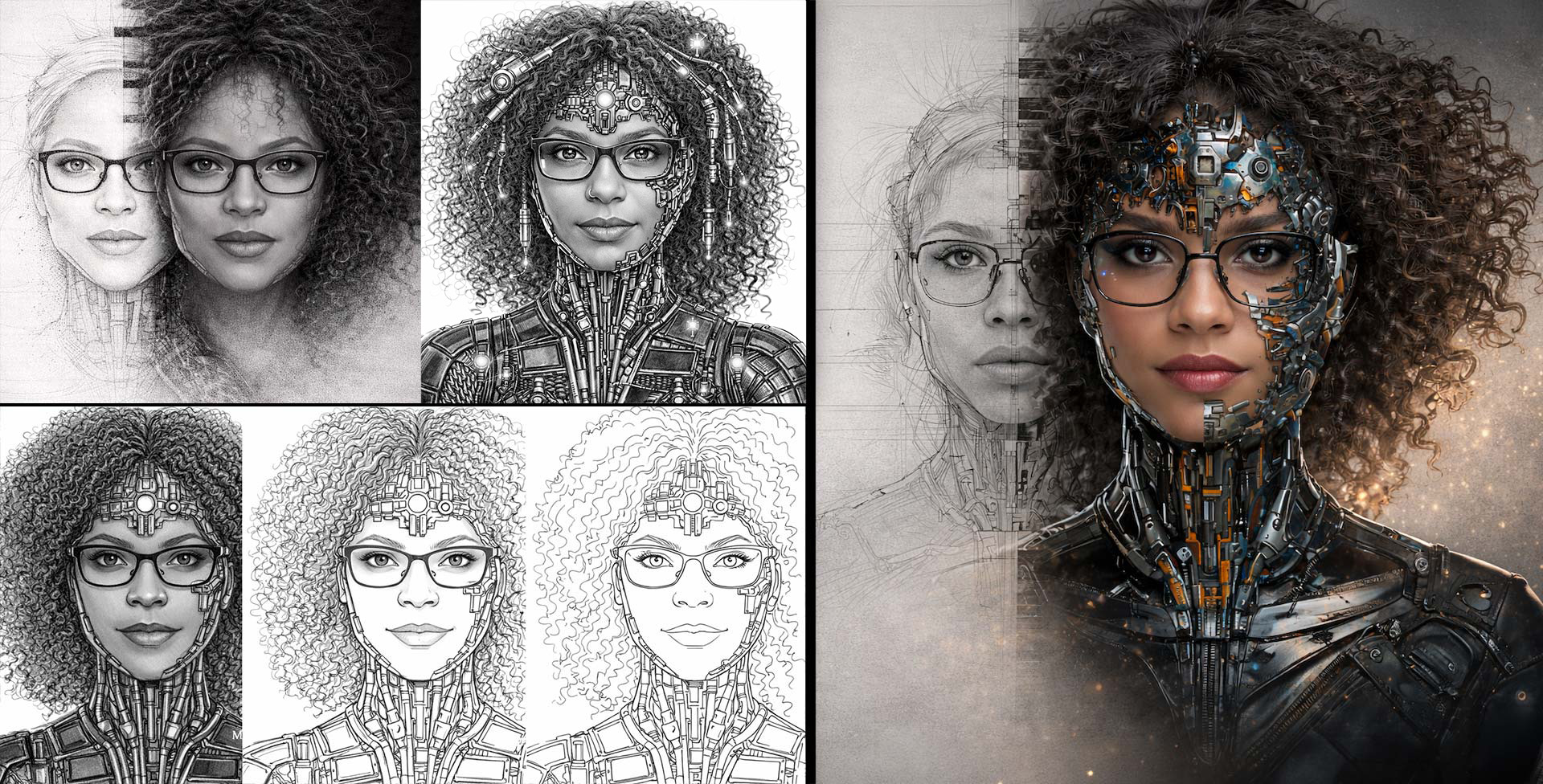
Using the Leonardo / Seedream output, together with the original source photographs, as new reference material fed back into ChatGPT opened something unexpected. For the first few iterations, ChatGPT produced remarkable black and white pencil sketches alongside photorealistic colored cyborg illustrations. Not the seamless single-image transition the original concept aimed for, but something that brought the concept to life in a different and equally compelling way.
A split-face composition emerged: pencil blueprint on one side, cybernetic realism on the other. The same person across both halves. The same glasses. The same proportions. And by combining the Leonardo / Seedream likeness reference with the original photographs, ChatGPT was then able to produce the cyborg that looked most like the actual subject.
That composition became the hero image and branding for the new website and LinkedIn pages.
Leonardo / Seedream
Pencil to Cyborg Transition Explorations
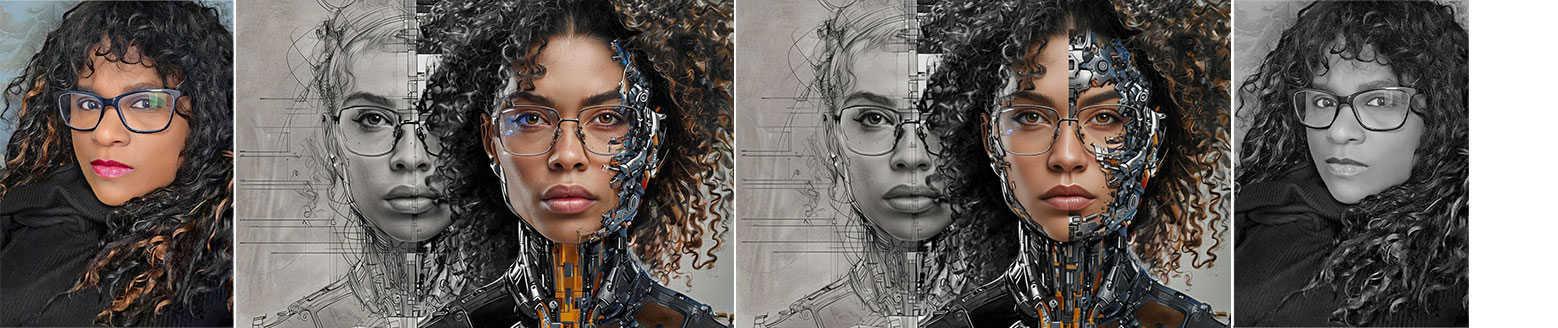
ChatGPT / DALL·E
Getting Closer: The Concept Coming Into Focus
The Prompt based on the Final Image
Once the workflow was understood, the prompt became highly explicit across five distinct areas: Identity preservation, transformation mechanics, rendering style, composition, and transition alignment. This is the master prompt given to me by ChatGPT when asked how it would prompt/describe the right-hand-side Pencil-to-Cyborg Transition image it produced.
MASTER PROMPT
Ultra-detailed split-face transformation portrait of the SAME woman transitioning from pencil sketch to advanced cybernetic human.
LEFT SIDE: A monochrome graphite pencil rendering with visible sketch strokes, drafting lines, construction marks, technical diagram overlays, and soft paper texture. The portrait should feel hand-drawn and architectural, like an artist's concept sketch in progress. Mechanical framework hints subtly emerging beneath the drawing.
RIGHT SIDE: The exact same woman transformed into a highly realistic futuristic cyborg. Preserve exact facial identity, proportions, bone structure, eyes, nose, lips, expression, skin tone, and facial asymmetry from the reference image. Do NOT alter the identity or replace the person with a generic AI face.
The cybernetic side should contain: intricate mechanical plating, micro-components, exposed circuitry, metallic facial integrations, neck robotics, and layered biomechanical details seamlessly fused into the skin.
The transition line down the center must align perfectly: same eyes, same mouth position, same facial proportions, same glasses alignment.
Curly hair should remain natural and voluminous across both sides, flowing organically while partially integrating into the cybernetic structures on the robotic side. Glasses must remain consistent and believable across both halves of the face.
Lighting should be cinematic but balanced: soft realistic skin lighting, controlled highlights, subtle metallic reflections, high facial clarity. Composition: symmetrical centered portrait, tight crop, direct eye contact, editorial sci-fi aesthetic, high realism, clean background, premium cinematic quality.
NEGATIVE PROMPT
DO NOT: Change identity, replace the person, beautify the face excessively, alter facial proportions, misalign the split, create duplicate features, distort glasses, add extra eyes, create asymmetrical eye positions, overcrowd the mechanical side, use cartoon or anime styling, create plastic skin, generate blurry details, overexpose highlights, add random sci-fi clutter, change hairstyle, change ethnicity, or create generic AI beauty-face features.
The negative prompt was equally important to the positive one. What you tell the AI not to do is often the difference between a result that holds identity and one that quietly replaces the person with a face that only resembles them.
ChatGPT / DALL·E Photoshop Refined
Final Result: Pencil-to-Cyborg Transitions, as used on the new site and LinkedIn
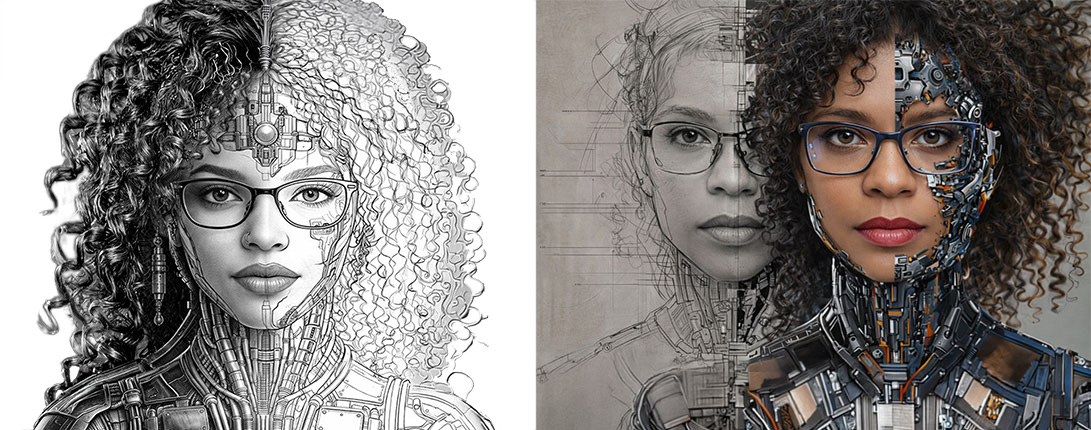
What This Image Actually Does
The final composition succeeds structurally because it is doing five sophisticated things simultaneously. It preserves identity consistency across two radically different render styles. It maintains exact facial alignment down the center split. It transitions from sketch to cybernetic realism while keeping the glasses consistent across both halves. And it uses the pencil side almost like an architectural blueprint for the person being built on the right.
That is a much harder AI problem than most people anticipate. Most prompts describe the aesthetic. This image succeeds because the real challenge was keeping this the same person while transitioning between two rendering realities. Knowing what the problem actually was, shaped every decision in the prompt.
What Happens When You Keep Pushing
After the images that would become the final site branding were in hand, the work continued. Not because more was needed, but because understanding where the tools break is as valuable as knowing where they hold.
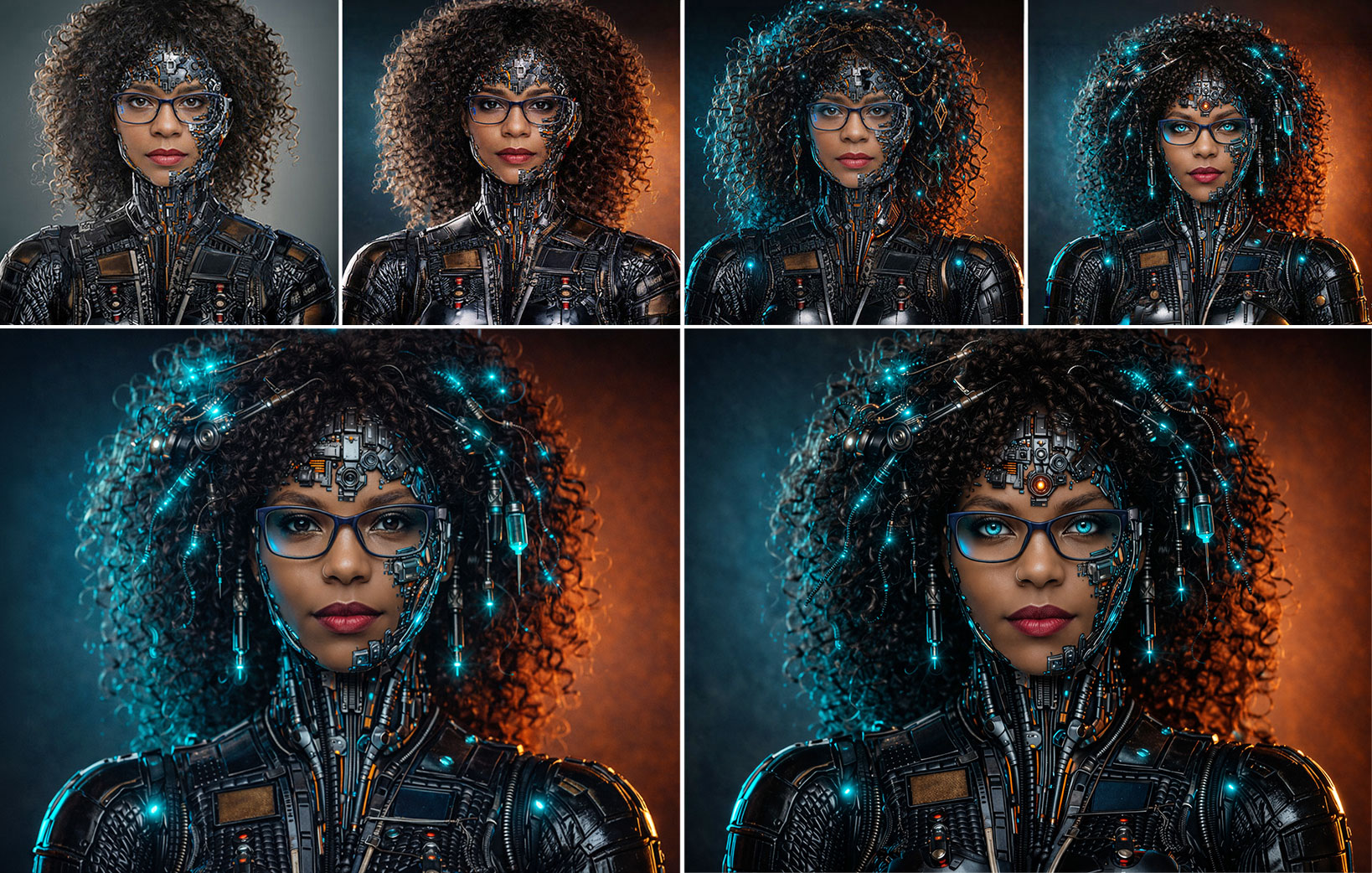
The more ChatGPT was pushed beyond its stable zone, the more inconsistencies compounded. Complexion shifted, becoming darker with each iteration. Proportions softened. The hair became progressively more dramatic (wild and wooly) and less accurate, eventually reading as a stylized lion's mane rather than the actual subject's curls. That is the nature of identity drift. It is cumulative and directional. Each iteration does not refine what came before. It reinterprets the last output, and every reinterpretation introduces new probability. Push far enough and you are no longer correcting the image. You are generating something adjacent to it.
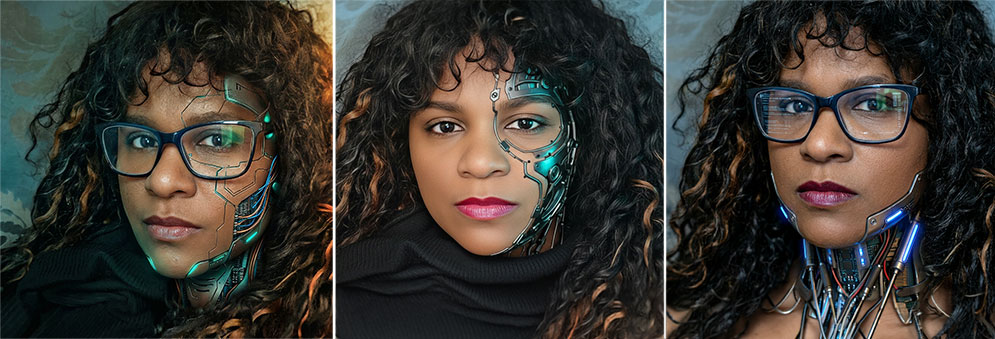
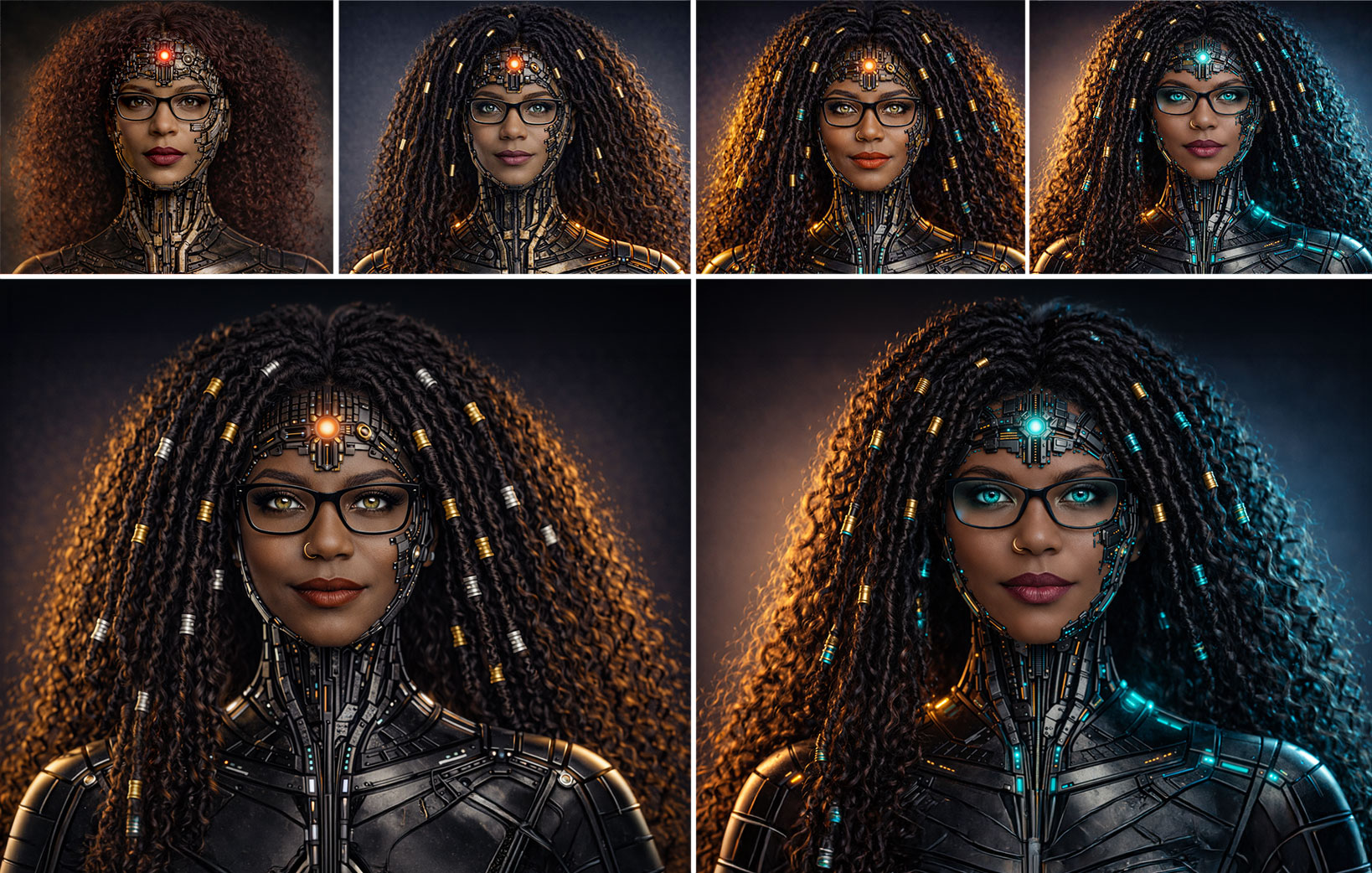
At a certain point the direction split. Rather than continuing to fight the AI's interpretation (where black hair had to be depicted as coarse, wild and wooly, and skin tone as dark), one branch leaned into it. A reference image of a Black woman with locs was provided, and ChatGPT was asked to restyle the cyborg's hair accordingly. Once it was directed on color coordination and lighting consistency, the result was actually striking. But it required accepting the AI's assumption of what a Black woman looks like, which did not reflect the actual subject, who is mixed-race and reads as more Hispanic than African.
That gap between what the AI assumed and who the person actually is became one of the more honest observations to come out of the entire process. Leaning into the AI's interpretation is a legitimate creative choice. But it requires knowing when you are making that choice deliberately, versus when the AI has simply taken the wheel.
ChatGPT / DALL·E
Human-to-Cyborg Transition: Pushing Further (Click on image to VIEW LARGER)
ChatGPT / DALL·E
Leaning Into the AI's Interpretation: Locs Reference (Click on image to VIEW LARGER)
Finishing Where AI Could Not
Even the strongest AI outputs were not final. The last stage of every piece happened in Photoshop: correcting facial structure, cleaning up noise and artifacts, refining the transition between pencil and photorealistic elements, strengthening lighting and contrast, and bringing the overall clarity back up to the standard the work needed to meet.
This is where the real difference shows. AI generates quickly. It explores directions and produces results that would take days to achieve manually. But the final layer of polish, the part that makes work feel complete rather than generated, still requires a human hand and a trained eye. That is not a criticism of AI. It is an accurate description of where these tools currently live in a professional workflow.
Two Images. One Concept. Two Different Answers.
The AI found its own way to tell the story. Photoshop told it the way it was always meant to be told. Both are valid. Only one was the original vision.
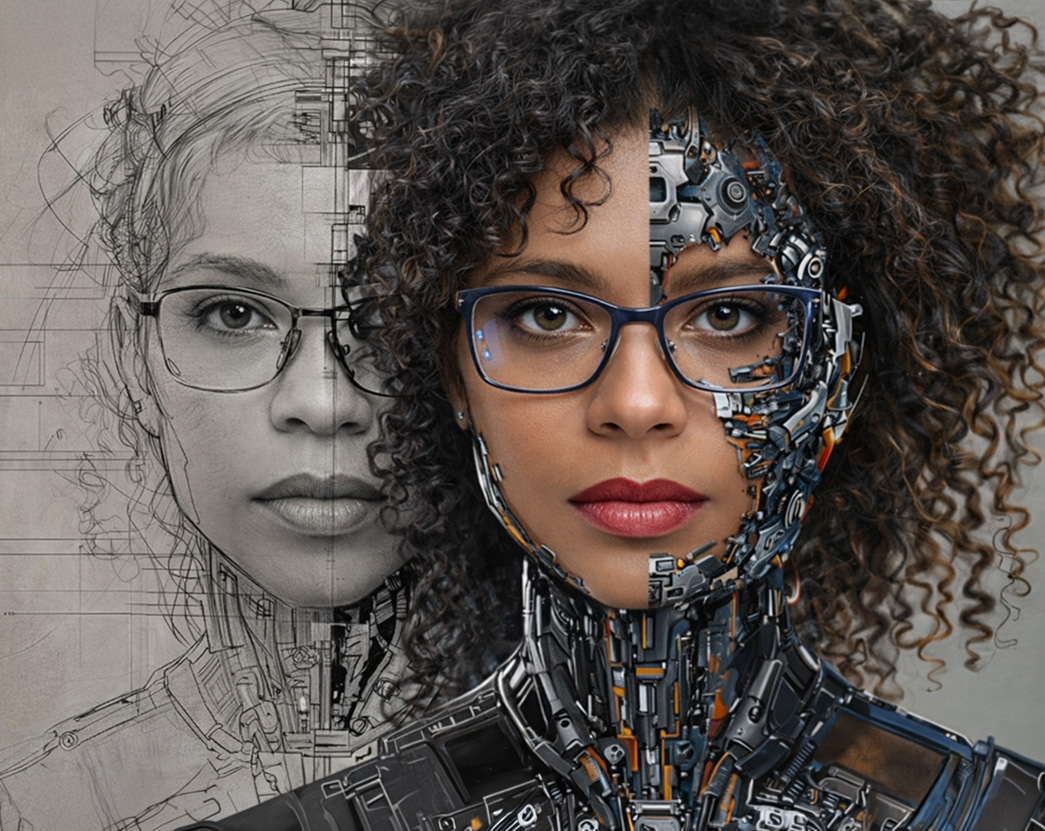
The AI's answer: a split-face composition moving from pencil sketch to cybernetic realism across a single portrait — a solution the tools found on their own terms.
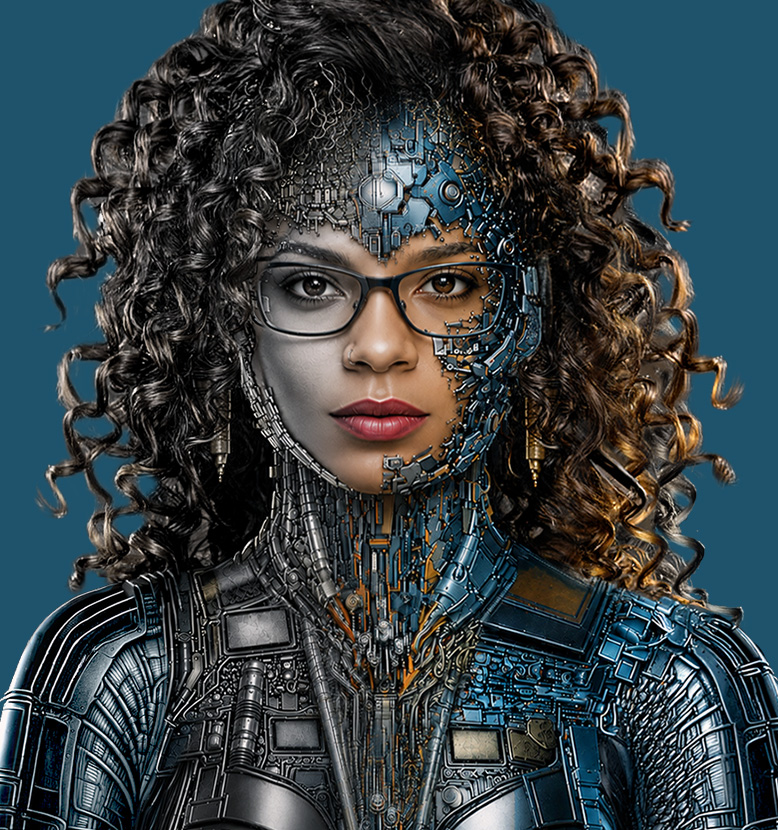
The original vision: one face, three states, one unbroken identity moving from pencil blueprint through human to augmented — the image no prompt could produce, built by hand.
The AI-driven result and the human-refined result share the same concept and the same subject. What separates them is authorship. One emerged from probability. The other from intent. Knowing the difference, and knowing when to step in, is what design direction actually means in an AI workflow.
Photoshop Refined
Final Result: The Pencil-to-Cyborg Transition
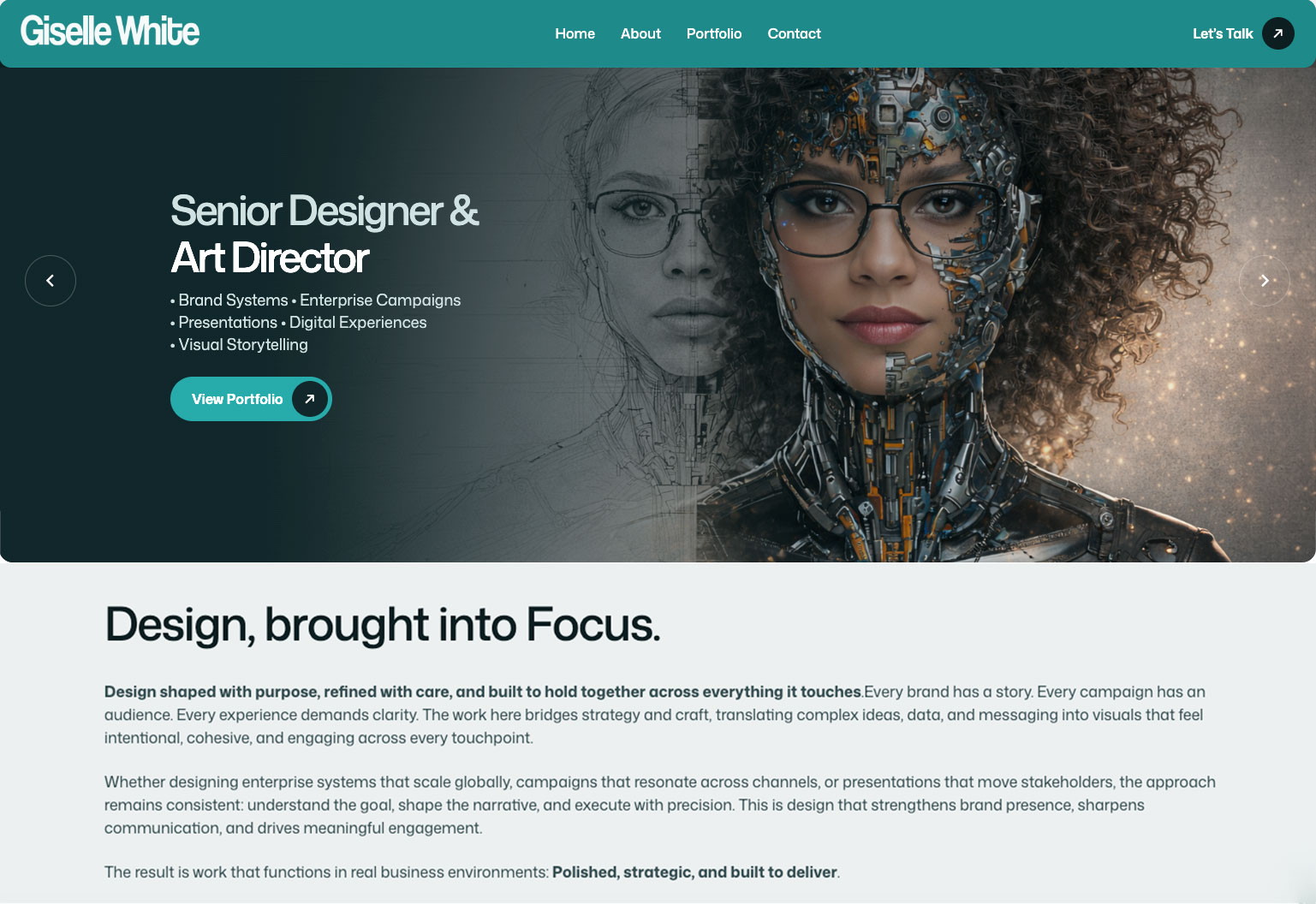
Photoshop Refined
Final Result: Cyborg Collateral — As Used on Social Media and the New Site
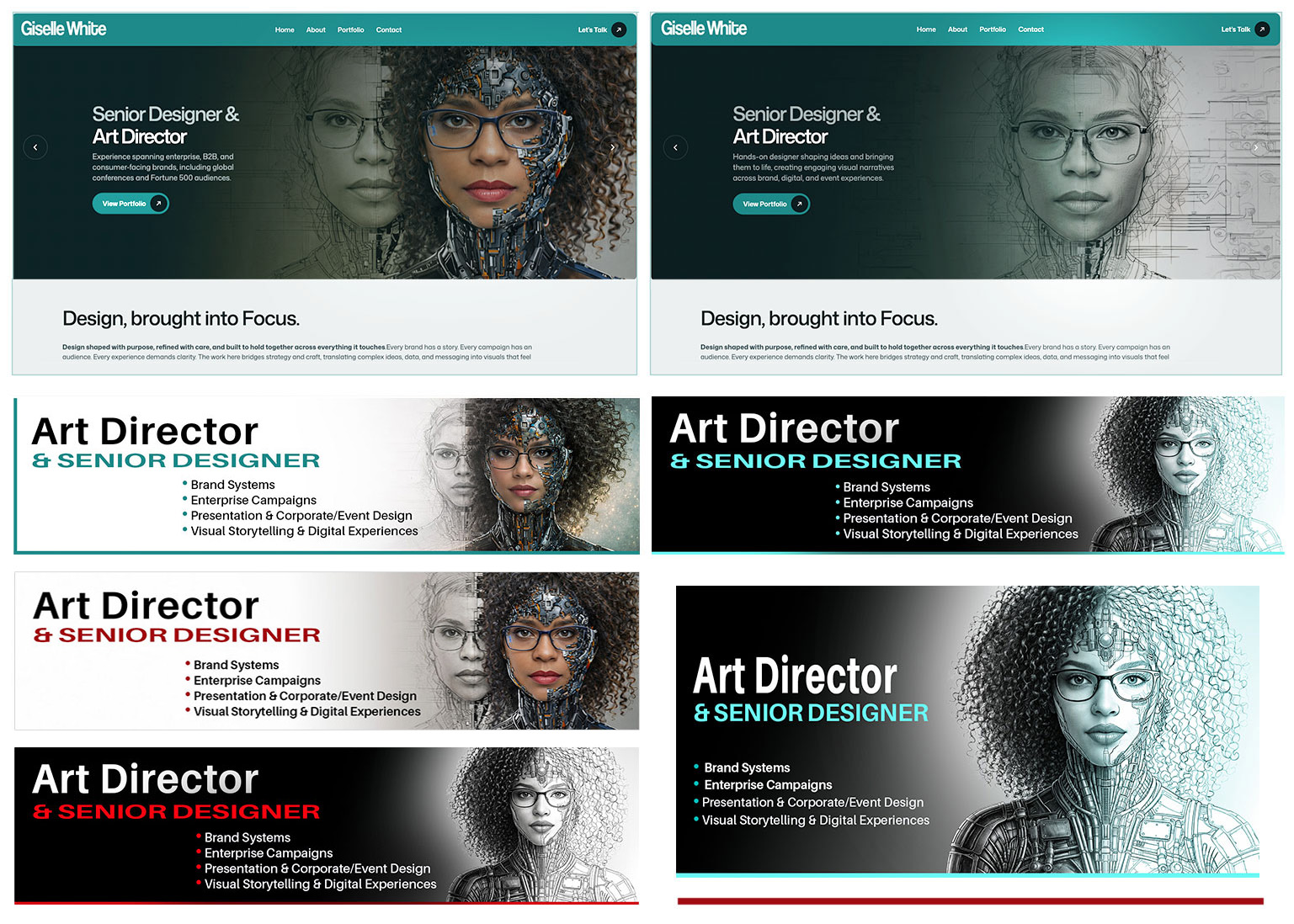
What This Process Revealed
Two to three days of sustained exploration across multiple AI platforms produces a clear set of working conclusions that go well beyond this single project.
Prompts are not universal. Each platform responds to direction differently, and learning those differences changes how you work with each one. What gets strong results from Leonardo will flatten in Firefly. What ChatGPT handles well in composition it loses in identity. Understanding the tool is part of using it effectively.
More iteration is not always better. There is a point in every AI workflow where continued generation starts breaking the image rather than improving it. Knowing when to stop generating and start refining is a skill that does not come from the tool. It comes from design experience.
Identity drift is cumulative and directional. Negative prompts are structural, not decorative. And leaning into an AI's interpretation is a legitimate creative choice, but only when you are making it deliberately.
The most important conclusion: this is not about what AI can produce. It is about what direction can achieve using AI as one tool among several. The work that emerged from this process looks the way it does because of the decisions made, the pivots taken, the standards maintained, and the willingness to go back into Photoshop when the generated result was not good enough. That discipline does not change, regardless of what tools are in the workflow.
What This Work Demonstrates
Multi-platform AI literacy: Understanding what ChatGPT, Leonardo, Seedream, Firefly, and Playground each do well, and building a cross-tool workflow that uses each platform for what it actually excels at rather than forcing one tool to carry everything.
→Art directing AI rather than following it: Moving from describing what the image should be to controlling what it cannot do, knowing when more iteration is making things worse, and understanding identity drift before it takes the image in the wrong direction.
→Prompt architecture as craft: Building prompts that separate identity preservation, transformation mechanics, rendering style, composition, and transition alignment into explicit, distinct instructions, and using negative prompts as structural creative decisions.
→Photoshop as the finishing layer: Understanding that AI gets you most of the way there, and that the final level of polish, the part that makes the difference between generated and designed, still requires a human hand, a trained eye, and an uncompromising standard.