
Case Study 8:
XTEK Partners

Making Complex Technology Services feel clear with Website Design & Information Architecture
XTEK Partners is an Ohio-based IT infrastructure support and reseller operating across government, commercial, education, and small business sectors. The company offers a broad spectrum of services: consulting and integration, wireless networking, maintenance and repair, networking and storage, sales and support, remote monitoring, security, and staff augmentation. In the right hands, that range of capability is a competitive strength. Without clear organization, it becomes noise.
The goal of this project was to design a clear, structured website that could communicate a broad and complex set of services, while reinforcing credibility, technical expertise, and trust. This project was straightforward in concept and demanding in execution: Design a website that communicates the full breadth of XTEK's services without overwhelming the people who need to find and understand them quickly. For a technology services company, credibility lives in clarity. If your website is hard to navigate, it signals that your services might be too.
The Company
XTEK Partners serves clients who outsource their IT operations entirely, which means the company needs to project confidence and competence to decision-makers who may not be technical themselves. A school district administrator evaluating IT support, a government procurement officer reviewing vendors, a small business owner trying to understand what managed services actually means. These audiences all arrive at the same site with different levels of technical knowledge and different questions they need answered.
The site also needed to reflect XTEK's credentials: Ohio MMA, EDGE and DBE certified, with established partnerships across major technology brands and a track record serving clients like Ohio Dominican University and Hilliard City Schools. That credibility had to be visible and accessible, not buried.
The Challenge
IT infrastructure companies face a specific design problem: Their service offerings are genuinely complex, but their audiences include both technical decision-makers and non-technical executives, who need to trust the company before they understand every service it offers. The website has to work for both.
The Challenge: The primary challenge was translating a wide range of technical services into a website that feels clear, navigable, and professional.
Homepage: Structure & First Impression
View Website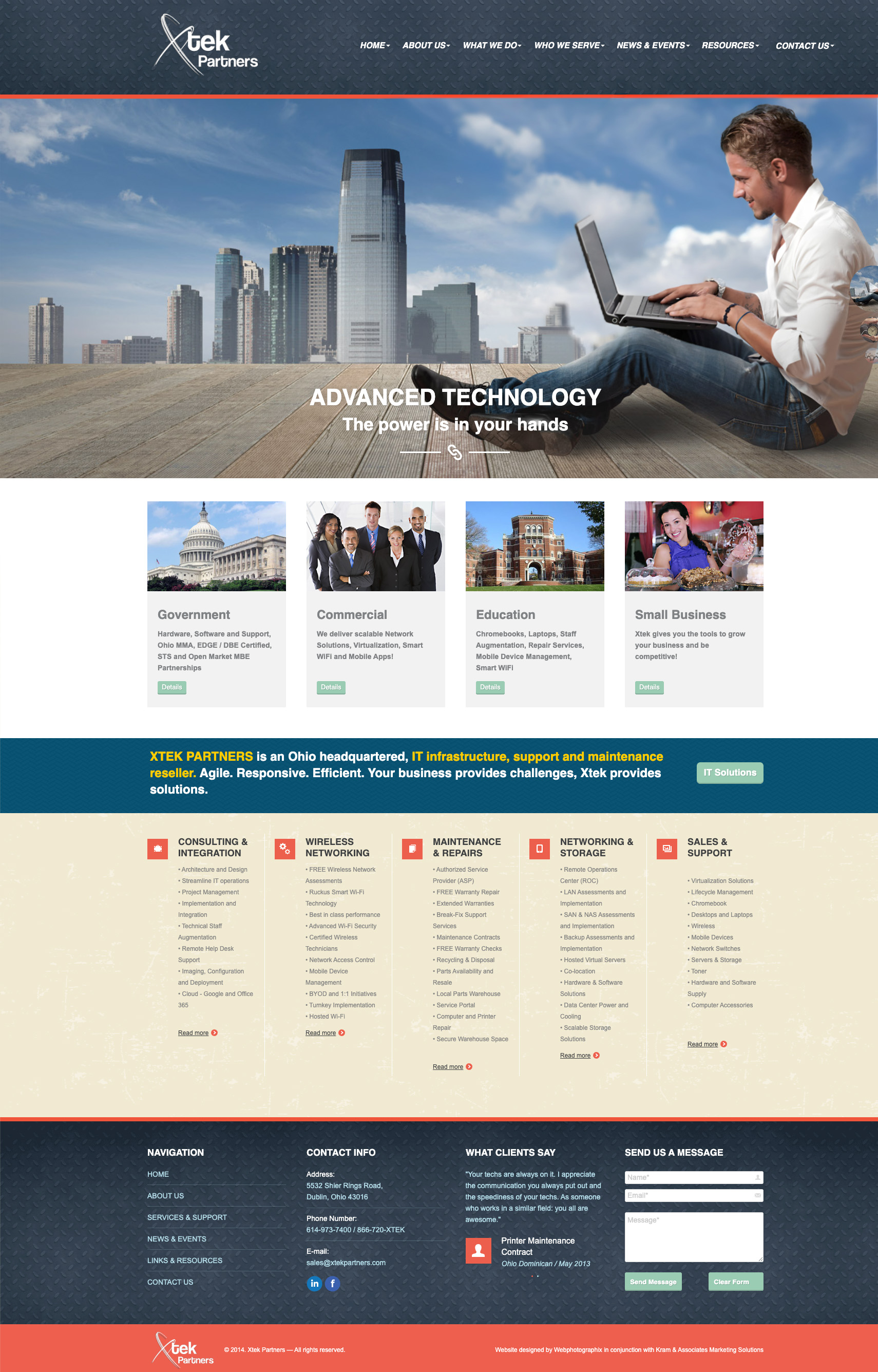
My Role
I led website design and front-end development for the project, working in collaboration with Kram & Associates on the broader marketing strategy. My responsibilities included information architecture, content organization, navigation design, visual design, and front-end development. More than anything, the work was about bringing structure to complexity.
XTEK offered a broad range of services across multiple industries, and the website needed to help visitors quickly understand what the company did, who it served, and why it was qualified to do it. Every design decision was guided by clarity, making information easier to find, easier to understand, and easier to trust.
The Approach
Clarity Over Complexity: The design philosophy for this project was clarity over complexity. Every decision was made in service of making XTEK's capabilities easier to find, easier to understand, and easier to trust. That required thinking carefully about structure before thinking about aesthetics.
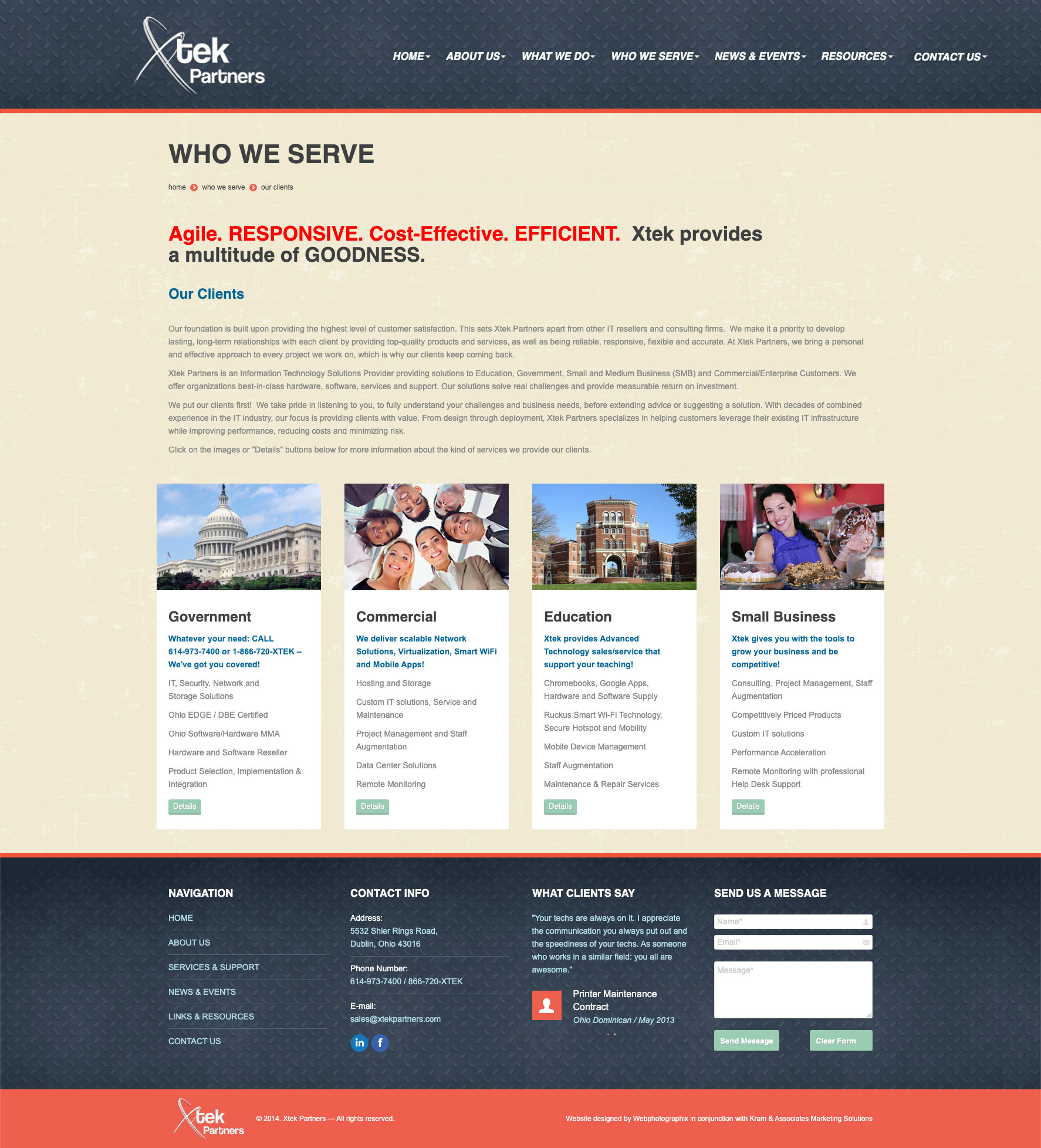
Information Architecture & Content Organization:The information architecture organized XTEK's services across two distinct structures running in parallel: What they do (consulting, networking, maintenance, security, sales) and who they serve (government, commercial, education, small business). This dual navigation allows different visitors to find their entry point naturally:A school IT director goes straight to Education, while a procurement officer scans services. Both paths lead to the same company, with relevant context at each stop.
Professional Tone & Visual Restraint: Visually, the approach was restrained and professional. Technology services companies earn trust through competence and reliability, not visual flash. Clean layouts, consistent hierarchy, and clear headings do more for a company like XTEK than dramatic design choices would. The hero slider established immediate credibility through messaging: "Fixed Fast. Fixed Right. Authorized Warranty Repair." and "Agile. Responsive. Efficient." letting XTEK's value proposition lead before any visitor has scrolled an inch.
Credibility & Trust: Client testimonials were surfaced prominently, providing social proof from named organizations (Ohio Dominican University, Hilliard City Schools) that carry weight with XTEK's target audiences in the Ohio market.
Scalable Structure for Growth: The framework supports future expansion, allowing additional services, resources, and content to be added without disrupting the overall structure.
Services Architecture & Navigation
View Website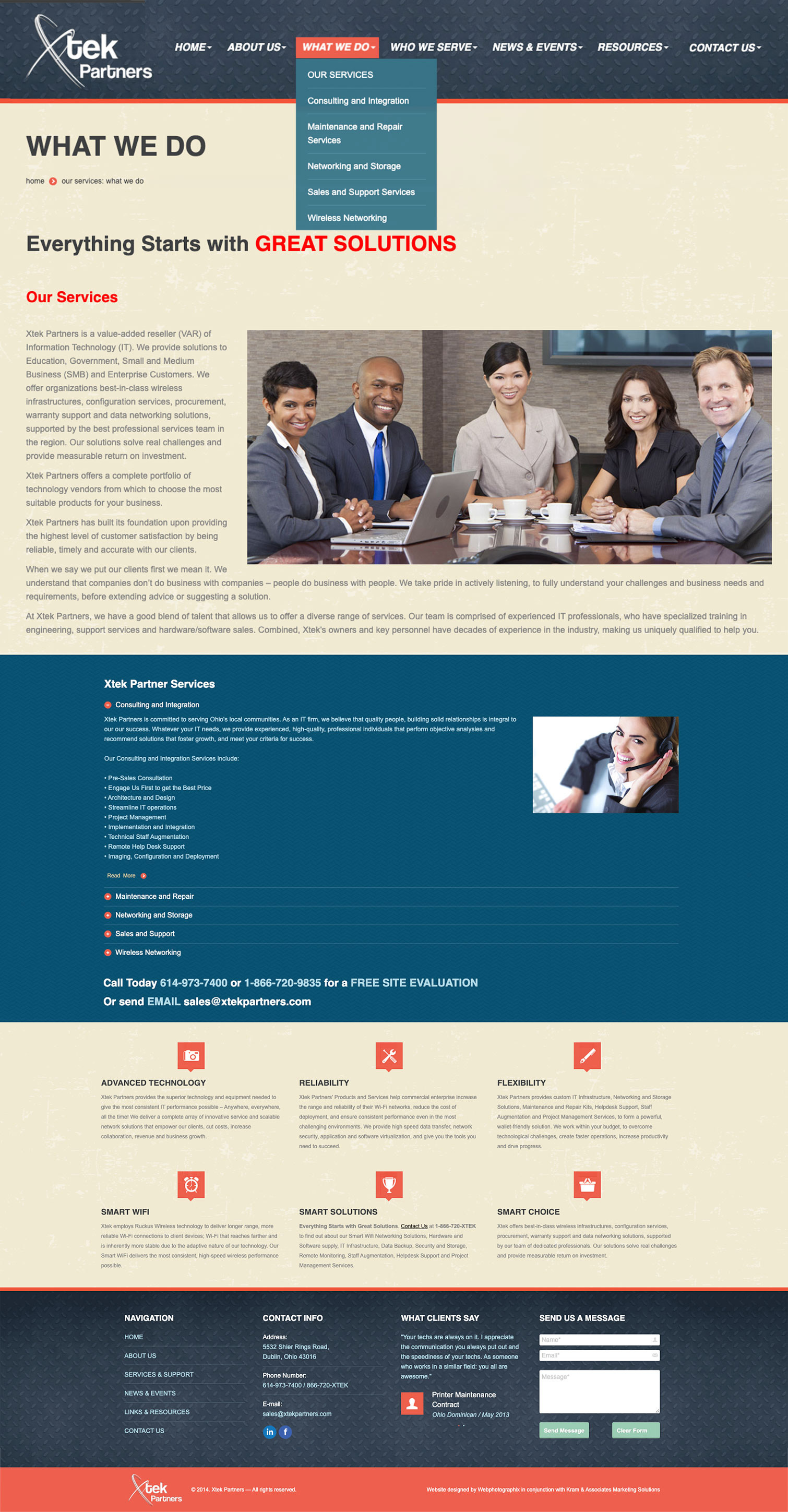
Audience Segmentation: Government, Commercial, Education, Small Business
Interior Service Pages
View Website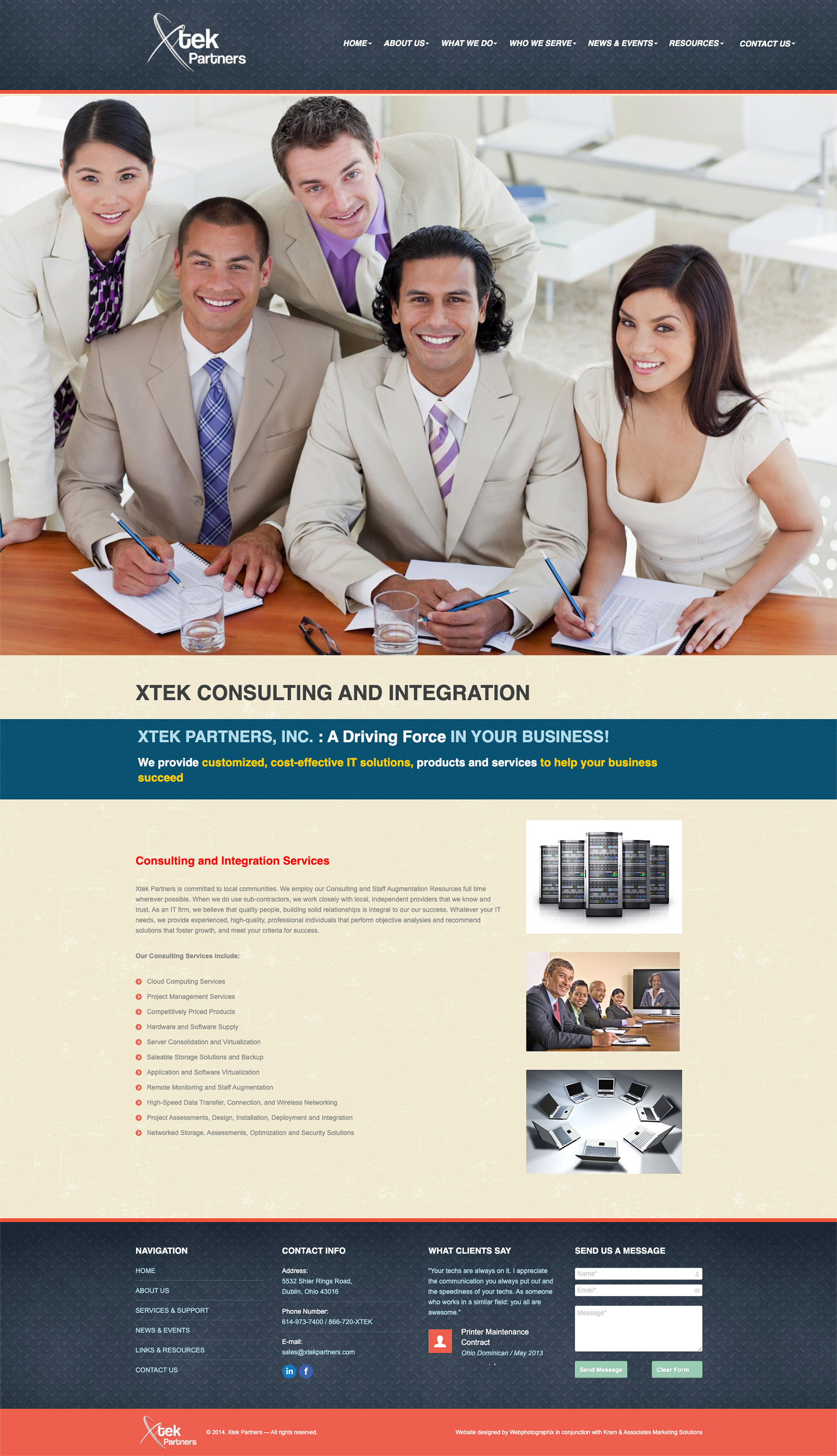
The Result
The XTEK Partners website functions as a clear, structured digital presence for a company whose value proposition can be difficult to communicate quickly. It organizes a genuinely complex range of services into a navigable, professional experience that serves both technical and non-technical decision-makers. The dual navigation structure, by Service and by Audience, means different visitors find relevant information without wading through content that doesn't apply to them.
The site was designed to scale. As XTEK adds services, partnerships, or sectors, the framework accommodates that growth without requiring a structural redesign. That kind of forward-thinking architecture is what separates a website that works today from one that still works in three years. The site supports both business development and client trust, functioning as a reliable digital foundation for a company operating in a highly technical and competitive space.
What This Work Demonstrates
Information Architecture Thinking
Organizing a complex range of technical services into a structure that is immediately navigable for both IT and non-IT decision-makers, without oversimplifying or overwhelming.
Audience-first Design
Building dual navigation paths, by service type and by audience segment—so government clients, school administrators, commercial buyers, and small business owners each find a relevant entry point naturally.
Visual Restraint as A Strategic Choice
Understanding that for a technology services company, credibility comes from clarity and consistency, not visual complexity. The design earns trust by getting out of the way of the content.
Scalable Framework Design:
Building a site structure that accommodates future service additions, new audience segments, and content growth without requiring structural rework, a digital foundation built to last.
The Impact
The final website transformed a broad and highly technical service offering into a clear, structured digital experience that was easier for prospective clients to navigate and understand. By organizing complexity rather than adding to it, the design strengthened both usability and credibility.